Walkway Mesh & Expanded Metal Grating Singapore: Load Class Guide
Walkway mesh — expanded metal grating specified for pedestrian and light-traffic access — is used across Singapore's industrial, commercial, and infrastructure projects wherever a solid floor isn't practical or desirable. The same heavier-gauge mesh is also specified within wall assemblies as structural reinforcement and security infill. This guide covers grating patterns, load classification, slip resistance, material grades, and how to specify walkway mesh correctly for your application.
What Is Walkway Mesh?
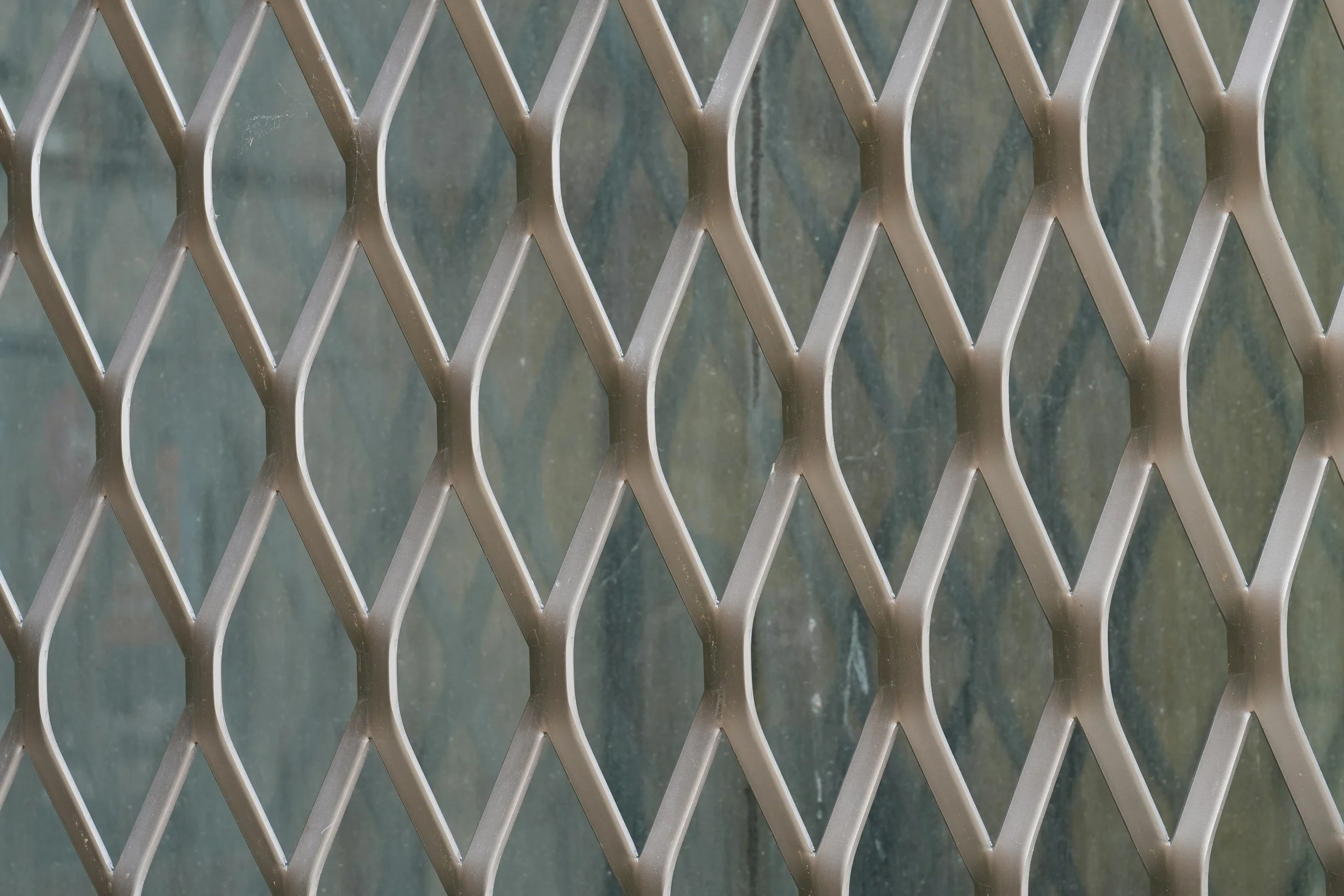
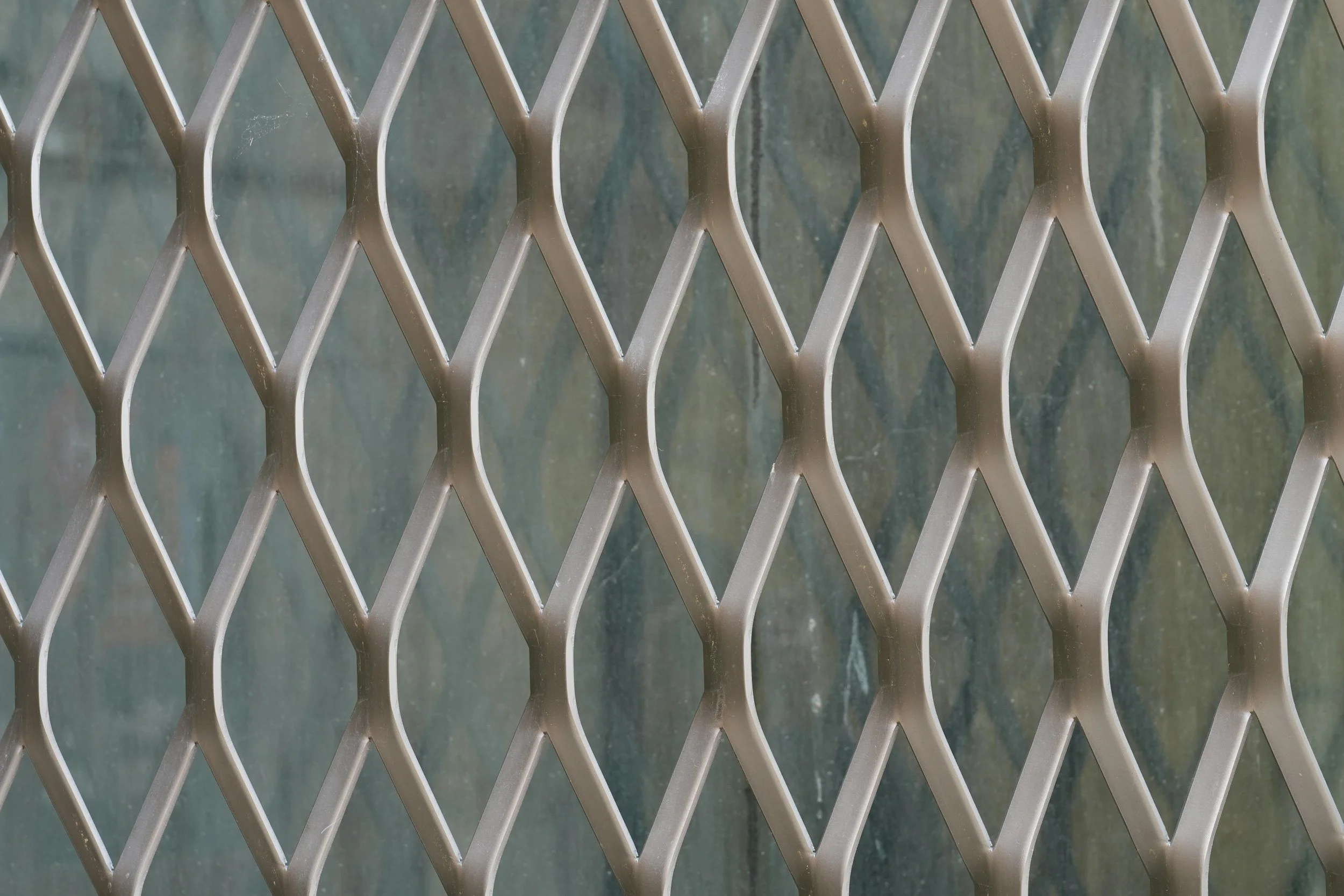
Walkway mesh is expanded metal manufactured from heavier-gauge steel plate, slit and stretched to form a raised diamond pattern rather than a flat one. The raised strands sit above the plane of the sheet, giving the surface grip underfoot that flat expanded metal doesn't provide. It's supplied as flat panels or as pre-formed treads, and is fixed to a supporting steel frame rather than used as a standalone floor.
The open pattern allows water, debris, and light to pass through the surface, which is why it's specified over solid plate wherever drainage or ventilation matters as much as load-bearing capacity. The same heavier gauge that makes it suitable for foot traffic also makes it suitable as a rigid layer within wall construction.
Walkway Mesh vs Alternatives
Walkway mesh competes with bar grating, perforated plank grating, and FRP (fibreglass) grating for the same applications. Each suits a different combination of load, cost, and corrosion environment.
| Material | Load capacity | Weight | Corrosion resistance | Typical cost | Best suited for |
|---|---|---|---|---|---|
| Expanded metal (walkway mesh) | Medium–high | Light | Depends on grade/finish | Lower | Platforms, catwalks, mezzanines, screening + walking surface combined |
| Bar grating | High | Heavy | Depends on grade/finish | Higher | Heavy vehicular or high-load industrial platforms |
| Perforated plank grating | Medium | Light–medium | Depends on grade/finish | Medium | Areas needing a flatter, more enclosed tread surface |
| FRP grating | Low–medium | Very light | High (non-metallic) | Higher | Chemical plants, wastewater, high-corrosion sites |
Product Range / Specifications
Supply Bay's walkway mesh range covers five standard models, spanning 3.0mm and 5.0mm thickness with mesh openings and strand widths suited to different load and open-area requirements.
| Model | Material | Thickness (mm) | Mesh Opening SWM (mm) | Mesh Opening LWM (mm) | Strand Width (mm) | Open Area |
|---|---|---|---|---|---|---|
| W30080 | MS/HDG | 3.0 | 30 | 75 | 8.0 | 70.1% |
| W50075 | MS/HDG | 5.0 | 30 | 75 | 7.5 | 70.6% |
| W50080 | MS/HDG | 5.0 | 135 | 38 | 8.0 | 78.8% |
| W50105 | MS/HDG | 5.0 | 30 | 75 | 10.5 | 63.1% |
| W50110 | MS/HDG | 5.0 | 45 | 135 | 11.0 | 73.1% |
Important: Walkway mesh load capacity depends on strand thickness, panel span, and the supporting frame — not the mesh alone. See the load/span table under Installation: Key Considerations, and always confirm the full assembly against your structural engineer's requirements before specifying.
Material Grade
| Grade | Corrosion resistance | Typical application |
|---|---|---|
| Mild steel (hot-dip galvanised) | Good for general external/industrial use | Warehouses, factories, general access platforms |
| SS304 | Good for indoor / low-corrosion environments | Covered walkways, indoor mezzanines |
| SS316 | High — suited to marine and coastal exposure | Waterfront sites, rooftop access, exposed platforms |
| Aluminium | Good, lightweight | Applications where reduced structural load matters |
Surface Finishes
| Finish | Description | Use case |
|---|---|---|
| Hot-dip galvanised | Zinc coating for corrosion protection | Standard for mild steel walkway mesh, external use |
| Mill finish | As-manufactured stainless finish | Where appearance is secondary to function |
| Powder coated | Colour finish over galvanised or mild steel base | Where the platform is visible and colour-coding matters (e.g. safety yellow) |
Common Applications in Singapore
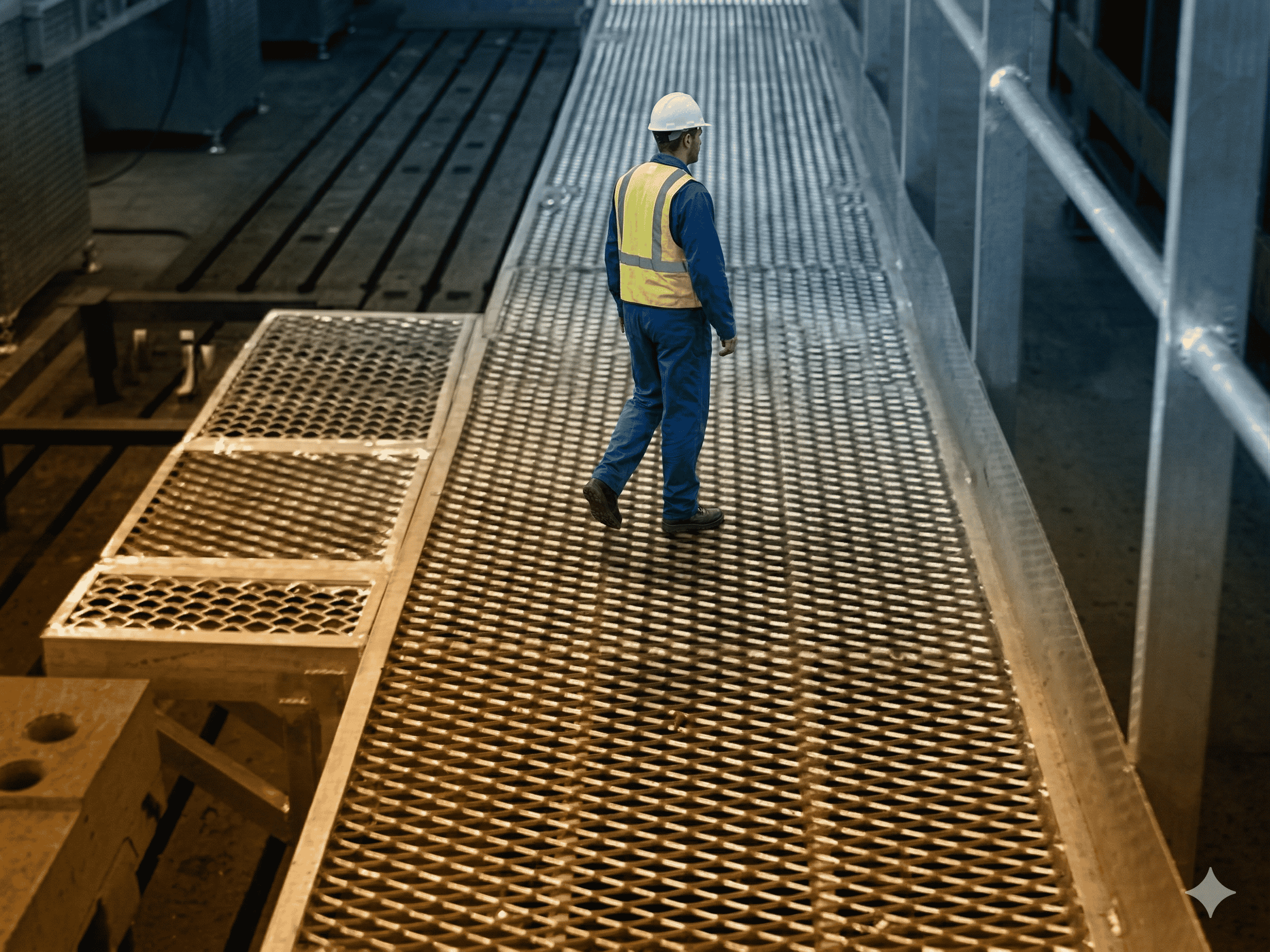
Industrial Platforms and Catwalks
Warehouses, factories, and plant rooms use walkway mesh for elevated access platforms and catwalks above equipment, where drainage and ventilation through the floor reduce corrosion and debris buildup.
Rooftop and M&E Access Walkways
Rooftop plant areas specify walkway mesh for maintenance access paths to M&E equipment, balancing weight (a factor in roof loading) against durability.
Wall Structural Support and Security Mesh
The same heavier-gauge expanded metal used for walkway grating is also specified within wall assemblies, where its rigidity and diamond pattern serve a different purpose.
As a structural reinforcement layer, it's embedded within rendered or plastered wall systems and cavity constructions to provide a rigid substrate that resists cracking and movement — a heavier-duty equivalent to lightweight expanded metal lath.
As security mesh, it's built into boundary walls, door and window infills, and cavity barriers on ground-floor units and perimeter fencing, where its strand thickness resists cutting and forced entry far better than lighter architectural mesh.
Both uses call for the same load-bearing gauges and grades covered in this guide, specified for concealment or embedment rather than a visible walking surface.
Mezzanine Flooring
Mezzanine levels in warehouses and industrial units use walkway mesh where full ventilation between levels is required for fire safety or airflow, rather than solid decking.
Public Use and Park Walkways
Elevated boardwalks and park access paths use walkway mesh where the structure needs to allow water and light through to vegetation or waterways below.
Installation: Key Considerations
Panel span and supporting frame spacing determine deflection under load. The table below gives maximum uniform and point load capacities by model, span type, and span length, based on mesh spanning in the Long Way Mesh (LWM) direction with minimum 25mm bearing and spot welding at every fourth strand.
| Model | Load Type | Simple Span (mm) | Double Span (mm) | Triple Span (mm) | ||||||
|---|---|---|---|---|---|---|---|---|---|---|
| 600 | 900 | 1200 | 300 | 450 | 600 | 200 | 300 | 400 | ||
| W30080 | Uniform (KN/m²) | Not Recommended | 7.25 | 2.61 | 1.82 | 19.13 | 8.50 | 4.78 | ||
| W30080 | Point (KN) | Not Recommended | 1.32 | 0.93 | 0.66 | 1.43 | 0.96 | 0.72 | ||
| W50075 | Uniform (KN/m²) | 5.70 | 2.50 | 1.50 | 23.50 | 10.70 | 6.00 | 51.00 | 25.00 | 14.00 |
| W50075 | Point (KN) | 1.30 | 0.80 | 0.60 | 2.80 | 1.90 | 1.40 | 4.40 | 2.00 | 2.20 |
| W50080 | Uniform (KN/m²) | 4.80 | 2.20 | 1.20 | 20.00 | 9.00 | 5.10 | 43.00 | 21.00 | 12.00 |
| W50080 | Point (KN) | 1.10 | 0.74 | 0.54 | 2.50 | 1.68 | 1.27 | 4.00 | 2.68 | 2.04 |
| W50105 | Uniform (KN/m²) | 8.20 | 3.65 | 2.02 | 33.80 | 15.30 | 8.60 | 70.00 | 36.10 | 20.50 |
| W50105 | Point (KN) | 1.80 | 1.22 | 0.92 | 4.20 | 2.80 | 2.10 | 6.40 | 4.56 | 3.45 |
| W50110 | Uniform (KN/m²) | 6.30 | 2.90 | 1.70 | 11.70 | 6.70 | 4.20 | 55.00 | 28.20 | 16.00 |
| W50110 | Point (KN) | 1.44 | 0.96 | 0.70 | 3.20 | 2.20 | 1.68 | 5.00 | 3.56 | 2.70 |
Span lengths in mm. Values reflect maximum loads without permanent deformation, incorporating a 1.4x safety factor. If some deformation is acceptable, loads may increase by up to 40%. Recommended spans assume deflection does not exceed span/200. Spans listed are nominal; deduct 25mm at each end for clear span.
Note: This load/span table is a guide only, based on standard bearing and fixing conditions. It does not replace a structural engineer's sign-off, particularly for spans, loads, or fixing methods that differ from the assumptions above.
Expanded metal walkway sheets can be bolted or clipped to the supporting frame to allow for removal during maintenance access to equipment or utilities. In other cases, sheets can be welded directly to the frame. When specified as wall reinforcement or security infill, walkway-grade mesh is fixed within the wall build-up rather than exposed, so coordinate embedment depth and fixing method with the main contractor's wall detailing before fabrication.
Frequently Asked Questions
-
Walkway mesh uses heavier gauge material and a raised strand profile for slip resistance and load-bearing. Architectural expanded metal mesh is typically flat and lighter gauge, made for facade screening and ventilation rather than foot traffic or structural in-wall mesh.
-
Load rating depends on model, span type, and span length — refer to the load/span table above for uniform and point load capacities by model. Final specification should still be confirmed against your structural engineer's calculation for your actual bearing and fixing conditions.
-
Yes. Its heavier strand thickness and rigid diamond pattern make it a common choice for security infill in boundary walls, cavity barriers, and window or door grilles.
-
Supply Bay has exstock of both Mild Steel and Hot Dip Galvanised versions of all expanded walkway mesh.
Supply Bay Pte Ltd supplies expanded metal walkway mesh for Singapore construction and industrial projects. Contact us at info@supplybaystore.com or +65 6524 3913.
Supply Bay is Singapore's leading supplier of architectural sheet metal — expanded mesh, perforated panels, laser-cut screens, and solid sheets in aluminum, stainless steel (SS304, SS316), mild steel, and galvanized steel.