
Perforated Metal Sheet Singapore: Facades, Ceilings, Acoustic Panels
Perforated metal sheet is a flat metal panel punched with a regular pattern of holes — round, square, slotted, or custom — to achieve a specific open area percentage. The solid sheet base is retained throughout, giving the panel structural integrity alongside the open area required for airflow, light transmission, acoustic absorption, or visual screening.
Supply Bay stocks expanded metal mesh in mild steel, galvanised steel (GI), aluminium, SS304, and SS316 stainless steel. Standard sheet size is 4FT X 8FT (1200mm W x 2400mm L). Custom cut-to-size and fabrication up to 1500mm W x 3000mm L is available. We supply Singapore contractors, architects, and QS teams directly, with stock delivery in 1–2 working days. Lead time for custom orders will be quoted on a case-by-case basis.


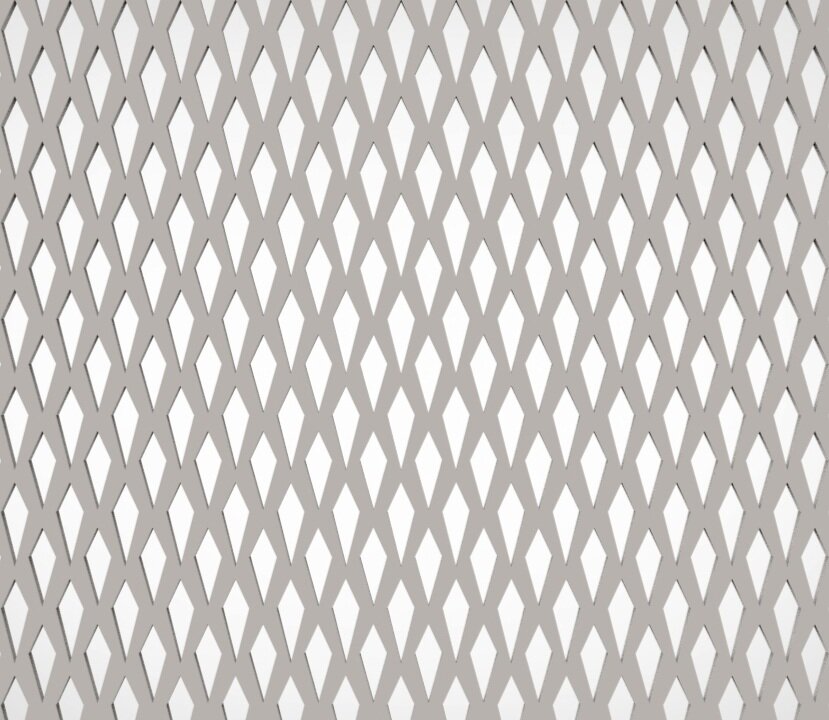




Perforated Metal vs Alternatives
| Property | Perforated Metal | Expanded Metal | Laser-Cut Panel |
|---|---|---|---|
| Surface profile | Flat — solid sheet base retained | Three-dimensional diamond strand | Flat — solid sheet base retained |
| Pattern options | Round, square, slot, hexagonal, custom | Diamond (standard) | Fully custom — any geometry |
| Open area range | 20–65% | 30–70% | 5–80% (custom) |
| Acoustic performance | Yes — with acoustic backing | Limited | Limited |
| Load-bearing use | Limited (5mm+ for walkways) | Yes (W-series walkway grades) | No |
| Lead time (SG stock) | 1–2 working days | 1–2 working days | 1–2 weeks (fabrication) |
| Best for | Facades, ceilings, acoustic panels, sunscreens | Facades, walkways, railings, ventilation screens | Decorative feature panels, signage, bespoke screens |
The Supply Bay Standard
4FT x 8FT (1.22m W x 2.44m L) standard sized sheets
Materials: Aluminium, Mild Steel, Galvanised Steel (GI), Stainless Steel (SS304, SS316
Thickness: 0.5mm - 6mm
Add-Ons
Custom sizes (maximum dimensions 1.5m W x 3m L)
Additional protective finishes for exterior applications
Additional powder coating or PVDF coating finishes
What Is Perforated Metal Sheet?
Perforated metal is manufactured by pressing a die through a flat metal sheet in a single punching operation, displacing rather than cutting the metal to produce clean-edged apertures without burring. The pattern, hole size, pitch (centre-to-centre spacing), and sheet thickness together determine the open area percentage — the key specification parameter for facade, acoustic, and ventilation applications.
Key parameters:
Hole diameter or slot dimensions: determines the scale of the perforation pattern and its visual density at distance.
Pitch: centre-to-centre spacing between holes; smaller pitch increases open area for the same hole size.
Open area %: the ratio of open to total surface area. Governs airflow, light transmission, and solar shading performance. For BCA Green Mark ETTV modelling, this figure is the primary input.
Sheet thickness: determines the panel's structural rating and its suitability for spanning between fixing points without secondary backing.
Perforation Patterns and Product Range
Round Perforation
Round holes in a staggered or straight-line arrangement are the most widely specified pattern for Singapore commercial and institutional projects. Staggered round perforation maximises open area for a given hole size and pitch, and distributes structural load evenly across the panel. Supply Bay stocks Round-1 through Round-4 grades covering hole diameters from 1.5mm to 10mm with varying pitch configurations.
Square Perforation
Square holes in a straight-line arrangement produce a more geometric, grid-like visual character than round perforation. Open area is comparable to round patterns at equivalent hole size and pitch.
Unique and Specialist Patterns
Supply Bay's custom perforated pattern range covers non-standard perforation geometries including hexagonal, slotted, and proprietary decorative patterns.
Applications
Building Facades and Sunscreens
Perforated metal is one of the primary facade screening materials for Singapore commercial, institutional, and mixed-use buildings. Aluminium panels with PVDF coating are the standard exterior specification — lightweight, dimensionally stable, and durable in Singapore's high-UV, high-humidity environment. Open area percentage is the critical design variable: higher open area reduces solar heat gain and improves ETTV performance but reduces the panel's visual opacity and structural span capacity.
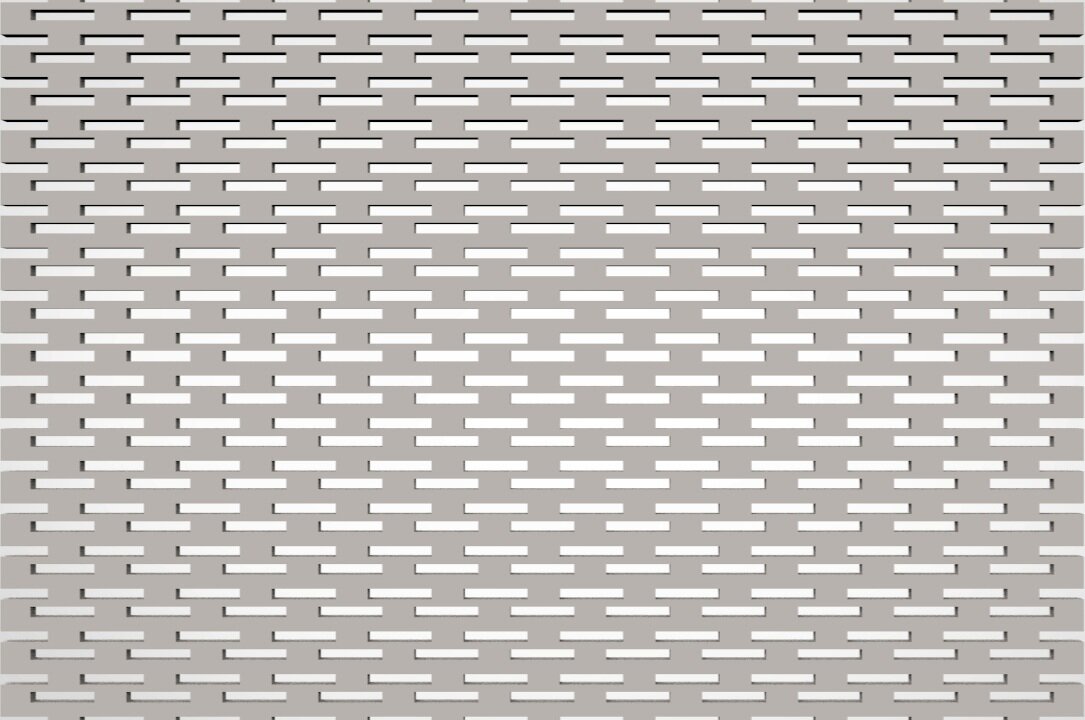
Case Study Project: The JTC CleanTech 3 development at Jurong Innovation District used a horizontal staggered slotted perforated pattern across screening zones — a non-standard specification that Supply Bay supplies from stock.
Acoustic Ceilings and Ceiling Panels
Perforated metal ceiling panels are used in commercial interiors, transport hubs, retail spaces, and institutional buildings across Singapore. The perforated face sheet — typically 0.5–1.0mm aluminium in a round staggered pattern — is mounted over a mineral wool or glass wool acoustic infill layer. The combination achieves NRC (Noise Reduction Coefficient) values of 0.7–0.95 depending on infill depth and open area. For F&B and retail fit-outs requiring a metal ceiling with acoustic performance, this system is the standard specification.
HDB Upgrading and Residential Programmes
Perforated metal sheet is a recurring material specification across HDB National Renewal Programme (NRP), Remaking Our Heartland (ROH), and Home Improvement Programme (HIP) projects. Lift lobby screens, void deck panels, corridor cladding, and estate boundary walls are the most common applications. Powder-coated mild steel or GI is the standard specification for sheltered locations; aluminium is used where weight reduction or a premium finish is required. Supply Bay has supplied perforated metal for NRP projects across Chai Chee, Tampines North, Toa Payoh, and Bukit Merah.
Decorative Screens and Interior Feature Walls
Unique perforation patterns are specified for interior feature walls, partition screens, lift lobby linings, and retail display fixtures. Pattern selection is predominantly an architectural decision; the structural and material grade follows from the installation context.
Ventilation Grilles and Industrial Screening
Round and square perforated sheets are used for HVAC ventilation grilles, AHU intake screens, plant enclosure panels, and machine guards across Singapore industrial and commercial buildings. GI or mild steel with powder coating covers most indoor industrial applications. SS316 is specified where chemical resistance or food-grade hygiene is required, common in process plant and food manufacturing facilities.
| Pattern | Grades | Typical open area | Visual character | Primary application |
|---|---|---|---|---|
| Round staggered | Round-1 to Round-4 | 35–65% | Uniform, neutral | Facades, ceilings, acoustic panels, sunscreens |
| Square straight | Square-1 | 30–55% | Geometric, grid-like | Decorative panels, ventilation grilles, partitions |
| Horizontal staggered slot | Unique range | 35–50% | Directional, horizontal rhythm | Green wall substrates, functional screening |
| Hexagonal | Unique range | 40–60% | Organic, honeycomb | Decorative facade, ceiling feature panels |
| Custom / bespoke | To specification | Variable | Project-specific | Architectural feature panels, signage screens |
Material Grades
| Material | Grade / Type | Corrosion resistance | Weight | Typical application |
|---|---|---|---|---|
| Mild Steel (MS) | — | Low (requires coating) | High | Interior partitions, acoustic panels, budget facade backing |
| Galvanised Steel (GI) | Hot-dip galvanised | Medium | High | Sheltered exterior screens, industrial ventilation, drain covers |
| Aluminium | 1100 / 3003 alloy | Good | Low | Facade cladding, ceiling panels, acoustic boards, lightweight screens |
| Stainless Steel | SS304 | Very good | High | Interior and semi-exposed exterior in non-coastal locations |
| Stainless Steel | SS316 / SS316L | Excellent | High | Coastal and waterfront facades, marine-adjacent structures, food processing environments |
Thickness Selection by Application
| Application | Recommended thickness | Notes |
|---|---|---|
| Ceiling panels and acoustic boards | 0.5–1.0mm | Concealed fixing; acoustic infill backing required for absorption |
| Interior partitions and feature walls | 1.0–2.0mm | Panel spans up to 1200mm without secondary backing |
| Facade panels and sunscreens | 1.5–3.0mm | Thickness to be confirmed by structural engineer against wind load |
| Balustrade infill panels | 2.0–3.0mm | BCA code compliance for balustrade infill to be verified by PE |
| Stair treads and walkways | 5.0mm and above | MOM/WSH Act compliance |
Surface Finishings
| Finish | Suitable materials | Application | Notes |
|---|---|---|---|
| Mill finish (bare) | All | Interior; primed and painted on site | Lowest cost; requires site finishing for exterior use |
| Hot-dip galvanising | Mild steel | Industrial exterior, sheltered screens | - |
| Powder coating | Mild steel, GI, aluminium | Architectural facades, ceiling panels, interior fit-out | RAL or custom colour; UV and impact resistant |
| PVDF coating | Aluminium | High-exposure exterior facade | Superior UV resistance; specified for BCA compliant building envelopes with long service life requirements |
Perforated Metals FAQ
-
Perforated metal is used across a wide range of architectural and industrial applications due to its strength, airflow, sound-control properties, and clean finish. Common uses include:
Architectural features: Facades, wall panels, ceilings, acoustic ceiling boards, sunscreens, rain screens
Noise control: Sound-absorbing panels, acoustic linings
Ventilation: Air vents, grilles
Safety and security: Machine guards, safety grates, protective enclosures
Filtration: Air filters, oil filters
Its versatility makes perforated metal a popular choice for commercial, residential, institutional, and industrial projects in Singapore.
-
Supply Bay offers perforated sheets in aluminium, stainless steel (SS304/SS316), mild steel, and hot-dip galvanised steel (GI).
The best material depends on your application. Typically, aluminium is for lightweight interiors, stainless steel for durability, and galvanised or mild steel for cost-effective structural use.
-
When choosing perforated metal, you will need to consider a number of factors, including:
Material
Sheet Thickness
Hole Pattern
Hole Size
Desired Finishing (Powder coat or PVDF
The best combination depends on your application and performance requirements. Our team can review your drawings or site use-case and recommend the most suitable option.
-
For perforated metal, typical thickness ranges are:
Ceilings/acoustic boards: 0.5 – 1.0mm
Internal partitions/feature walls: 1.0 – 3.0mm
Facades/sunscreens: 1.5 – 3.0 mm (depending on wind load and support)
Staircases/walkways: 5.0mm and above
For large panels or outdoor use, thicker materials offer better rigidity.
-
Standard sheets can be delivered within 1-2 working days, depending on stock availability. Custom fabrication or powder coating typically takes 1-2 weeks. Larger batch orders can be coordinated for phased delivery.
Supply Bay Metals
Supply Bay is a leading supplier of perforated metal sheets based in Singapore. We offer a wide range of products in various materials and finishes. Our flexible fabrication capabilities allow us to customise products to meet specific requirements, including different materials (aluminum, stainless steel (SS304, SS316), mild steel, and galvanized steel), and powder coating or fluorocarbon (PVDF) finishes.