Perforated Metal for HDB Upgrading Projects Singapore
Perforated metal is a standard material specification across Singapore's HDB upgrading programmes — the Neighbourhood Renewal Programme (NRP), Remaking Our Heartland (ROH), Home Improvement Programme (HIP), and BTO developments. This guide covers where perforated metal is used within these programmes, how to specify it, and what to consider at the procurement stage. It is written for main contractors, nominated sub-contractors, and town council project managers.
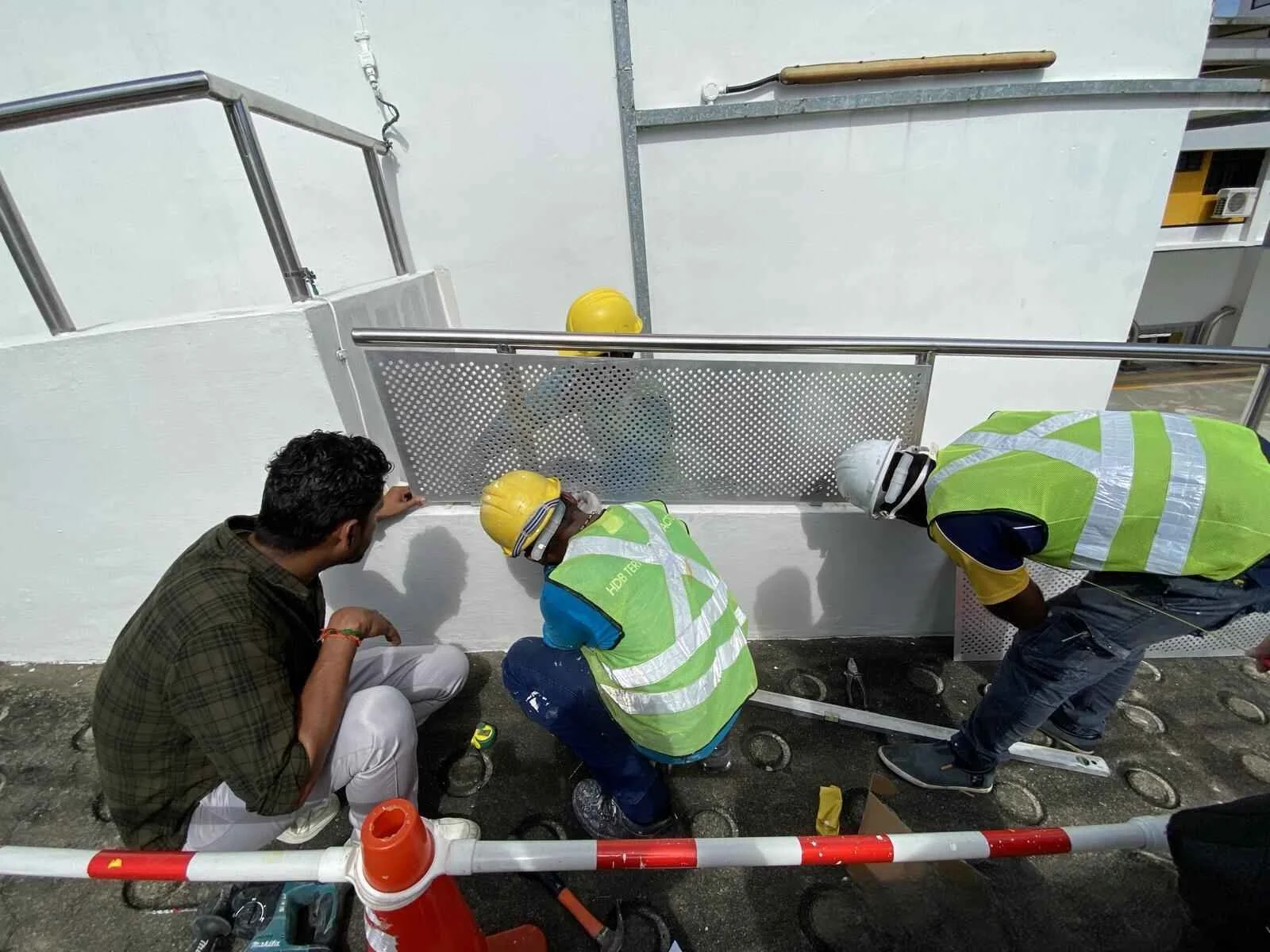
HDB Upgrading Programmes: Scope and Scale
Singapore's public housing estate renewal is an ongoing, island-wide process. Since its introduction in 2007, the NRP alone has committed more than S$1.5 billion across 229 projects. The 16th batch, announced in April 2025, covers 17 HDB neighbourhoods at a cost exceeding S$165 million, benefiting over 25,000 households.
The NRP focuses on block and precinct improvements, fully funded by the Government. Works are shaped through resident engagement — town hall meetings, dialogue sessions, and surveys — before scope is finalised. Block-level improvements can include new lift lobby tiling, upgraded residents' corners, and additional seating at void decks. Precinct-level works include covered linkways, drop-off porches, fitness corners, and community spaces.
The ROH programme operates at town scale — upgrading town centres, neighbourhood centres, parks, and connectivity networks. Toa Payoh is currently undergoing ROH works as part of the third batch, alongside Woodlands and Pasir Ris.
Both programmes generate consistent demand for architectural metalwork, including perforated metal panels, screens, and enclosures.
Where Perforated Metal Is Used in NRP and ROH Projects
The following are the most common perforated metal applications across HDB upgrading scopes:
Covered Linkway and Walkway Screens
Side panels, end screens, and decorative infill along newly constructed or upgraded sheltered connections between blocks. These are typically mild steel or aluminium, powder-coated to the Town Council's colour palette.
Void Deck and Common Area Screens
Perforated enclosures for residents' corners, community spaces, and seating areas at ground level. These screens define space without blocking airflow — important in Singapore's climate.
Bin Centre and Refuse Area Enclosures
Perforated panels allow ventilation while containing visual clutter and reducing odour transmission. Galvanised mild steel is the standard specification for outdoor refuse enclosures.
Lift Lobby Wall Panels
Decorative perforated panels at upgraded first-storey lift lobbies, replacing ageing concrete or tile finishes. These are often powder-coated aluminium to achieve lighter, more finished aesthetics.
Staircase and Balustrade Infill
Perforated sheet panels replacing ageing grille or solid infill in block staircases. Panels must comply with BCA structural requirements for balustrade infill, including opening size and load resistance.
Precinct Boundary and Planter Box Screens
Low-level perforated screens defining precinct edges, fitness corners, and garden boundaries. Typically mild steel or aluminium with powder coat finish.
Facade Enhancement Panels
Decorative perforated cladding as part of HDB's Facade Enhancement Programme, which addresses building facade wear and tear across more than 4,000 HDB blocks islandwide. Panel geometry and finish are typically specified by the architect or Town Council.
Material and Specification Guide
The table below summarises common material specifications by application for NRP and ROH projects.
Table 1: Perforated Metal Specifications by HDB Upgrading Application
| Application | Typical Material | Common Thickness | Typical Finish |
|---|---|---|---|
| Covered linkway screens | GI mild steel / aluminium | 1.5–2.0 mm | Powder coat |
| Void deck enclosures | GI mild steel / aluminium | 1.5–2.0 mm | Powder coat |
| Bin centre panels | GI mild steel | 2.0–3.0 mm | Hot-dip galvanised or powder coat |
| Lift lobby wall panels | Aluminium | 1.5–2.0 mm | Powder coat (custom RAL) |
| Staircase balustrade infill | GI mild steel / SS304 | 2.0–3.0 mm | Powder coat or mill finish |
| Precinct boundary screens | GI mild steel / aluminium | 1.5–2.0 mm | Powder coat |
| Facade enhancement panels | Aluminium | 2.0–3.0 mm | PVDF or powder coat |
Tip
For outdoor applications in Singapore, galvanised mild steel is the default cost-effective choice for non-visible enclosures. For visible or decorative panels, aluminium with powder coat or PVDF finish offers better long-term colour retention in Singapore's UV and humidity conditions.
For grade selection guidance, refer to the Stainless Steel vs Galvanised Steel guide.
Hole Pattern and Open Area Selection
The hole pattern affects both the panel's visual appearance and its functional performance — airflow, light transmission, and structural integrity.
Table 2: Common Hole Patterns for HDB Upgrading Applications
| Hole Pattern | Open Area (approx.) | Typical HDB Application |
|---|---|---|
| Round hole, staggered pitch | 40–65% | Linkway screens, void deck panels, facade infill |
| Round hole, straight pitch | 30–50% | Bin centres, enclosures requiring partial privacy |
| Square hole, straight pitch | 36–64% | Decorative lobby panels, precinct features |
| Slot hole | 20–50% | Balustrade infill, low-level screens |
Note: Higher open area reduces panel weight and improves natural ventilation but reduces structural rigidity. For panels spanning more than 1200 mm unsupported, specify a minimum thickness of 2.0 mm regardless of open area. Confirm panel fixing details with your structural engineer for BCA compliance.
For a full guide to open area, pitch, and hole sizing, see the Perforated Metal Sheet Buyer's Guide.
HDB and Public Housing Case Study
Supply Bay has supplied perforated metal and expanded metal mesh for a range of HDB-related and public housing upgrading projects across Singapore. The following are among the projects where our materials have been used.
NRP Chai Chee Road / Chai Chee Avenue — Perforated metal panels supplied for estate upgrading works in the Chai Chee precinct as part of the Neighbourhood Renewal Programme. The Bedok Town Council area projects in Chai Chee represent a typical NRP scope: covered linkway screens, precinct-level enclosures, and void deck improvements requiring durable, low-maintenance perforated metal in materials suited to outdoor Singapore conditions.
HDB ROH Toa Payoh — Perforated metal supplied for estate renewal works in Toa Payoh as part of the Remaking Our Heartland programme. Toa Payoh's ROH works have included the development of a 4km-long nature way along the ring road connecting most of the town, along with the upgrading of neighbourhood centres including Toa Payoh Palm Spring with more seating areas and greenery. Perforated metal panels and screens contribute to the covered structures, boundary enclosures, and amenity furnishing that support this kind of large-scale estate rejuvenation.
Tenteram Vantage BTO — Supply Bay also supplied expanded metal drain gratings for the Tenteram Vantage BTO development, one of the newer public housing projects in the Kallang-Whampoa area. View project →
Procurement Considerations for NRP and ROH Contractors
Material Submittals and Approval
HDB and Town Council projects require material submittals before installation can proceed. Supply Bay provides product data sheets, material certificates, coating test reports, and sample panels to support your submittal package. Build adequate lead time for the approval process into your construction programme from the start.
Cut-to-Size Supply
Standard sheet sizes rarely match the panel dimensions required for specific linkway bays, void deck enclosures, or lobby wall positions. Supply Bay supplies panels cut to your specified dimensions with clean, finished edges. This reduces site cutting labour and eliminates exposed cut edges that require touch-up treatment on galvanised material.
Phased Delivery
Large NRP projects involve multiple precincts and phased construction sequences. Supply Bay can coordinate phased material delivery aligned to your block-by-block programme, avoiding both storage constraints on site and delays to individual phases.
Lead Times
Standard perforated metal sheets in stock specifications are available within 1–2 working days. Custom cut-to-size panels, powder coating, or non-standard specifications are typically ready within 1–2 weeks. Contact Supply Bay early in your procurement process for programme-critical orders.
Important: NRP and ROH projects are programme-driven, with HDB and Town Council timelines that allow limited leeway for material delays. Confirm material specifications and place orders as early as possible, particularly for powder coat finishes that require additional processing time.
Perforated Metal vs Expanded Metal for HDB Upgrading
Both perforated and expanded metal are used in HDB upgrading projects, but they serve different applications.
Table 3: Perforated Metal vs Expanded Metal — HDB Upgrading Comparison
| Criteria | Perforated Metal | Expanded Metal |
|---|---|---|
| Appearance | Clean, regular hole pattern; smooth face | Diamond mesh pattern; textured surface |
| Open area control | Precise — specified by hole size and pitch | Less precise — determined by mesh type |
| Structural rigidity | Flat sheet; requires framing for large spans | Inherently rigid due to raised strand geometry |
| Typical HDB use | Screens, enclosures, lobby panels, facades | Drain gratings, walkway infill, safety barriers |
| Cut-to-size | Yes — clean cut edges | Yes — requires edge treatment to remove burr |
| Powder coat | Yes | Yes |
For applications where walkway drainage or structural load-bearing gratings are required, expanded metal mesh is the appropriate specification. For screens, enclosures, and decorative panels, perforated metal is standard.
-
The most common specifications are aluminium or galvanised mild steel perforated sheet for covered linkways, bin centres, and outdoor screens, and powder-coated aluminium perforated panels for decorative applications and precinct features.
Thickness, hole pattern, and finish vary by application and Town Council design requirements.
-
Standard stock specifications are available within 1–2 working days. Custom cut-to-size panels, non-standard hole patterns, or powder-coated finishes are typically ready within 1–2 weeks. Contact Supply Bay early in the procurement process for programme-critical orders.
-
Yes. Panels can be powder coated to any RAL or custom colour specification to match existing Town Council palettes or project design requirements.
-
Yes. Supply Bay supplies aluminium perforated panels with powder coat or PVDF finishes for facade cladding applications. Material data sheets and coating test reports are available for submittal purposes.
-
Yes. Supply Bay supplies perforated metal sheet, expanded metal mesh, and laser-cut metal panels to main contractors, nominated sub-contractors, and specialist metalwork contractors on HDB NRP, ROH, HIP, and BTO projects across Singapore. Product data sheets and material certificates are available to support contractor submittals.
Supply Bay Pte Ltd supplies perforated metal sheet, expanded metal mesh, and laser-cut panels for Singapore construction and architectural projects. Contact us at info@supplybaystore.com or +65 6524 3913.
Supply Bay is Singapore's leading supplier of architectural sheet metal — expanded mesh, perforated panels, laser-cut screens, and solid sheets in aluminum, stainless steel (SS304, SS316), mild steel, and galvanized steel.