
Metal Fabrication: Processes, Materials, and How to Choose the Right One for Your Project
Supply Bay - Local Metal Fabricator
Walk through any Singapore construction site, commercial fitout, or public space and you are surrounded by fabricated metal. The balustrade on a staircase. The facade screen on a commercial tower. The decorative panel in a retail store. The grating under your feet in a car park. All of it started as raw sheet or plate, and all of it went through a fabrication process to become what it is.
Most people outside the industry have a vague sense that metal fabrication involves cutting and welding — and they are not wrong. But fabrication covers a much wider range of processes, and choosing the right combination for a given project has a real impact on cost, lead time, finish quality, and long-term performance.
This guide breaks down the key metal fabrication processes, the materials most commonly used in Singapore, and how to think about which process is right for what you need.
What Is Metal Fabrication?
Metal fabrication is the process of transforming raw or semi-finished metal materials into a finished product or component. Rather than assembling pre-made parts, fabrication starts from flat sheet, plate, bar, or structural section and produces end products through a series of forming, cutting, joining, and finishing operations.
In practice, most fabricated metal products go through more than one process. A laser-cut facade panel might be cut, then bent, then powder coated. A perforated metal panel may be folded at the edges, and then brushed to finish. Understanding the sequence of processes and how each one affects the material, is what separates a well-specified job from an expensive mistake.
Key Metal Fabrication Processes
Cutting
Cutting is where almost every fabrication job begins.
Laser cutting is the process most relevant to custom architectural work in Singapore. A CNC-controlled laser beam vaporises the metal along a programmed path, producing clean, burr-free edges with tolerances as tight as ±0.1mm. It handles complex geometries and custom patterns that no other cutting method can achieve. Supply Bay's laser cutting service handles mild steel (up to 25mm), stainless steel (up to 20mm), aluminium (up to 12mm), and galvanised steel (up to 25mm), with a maximum sheet size of 3,015mm × 1,524mm.
Waterjet cutting uses a high-pressure stream of water mixed with abrasive particles to cut through metal without generating heat. Because it is a cold process, it avoids any heat-affected zone at the cut edge — important for materials where heat distortion or metallurgical changes would be a problem. Slower and more expensive than laser for most architectural applications.
Shearing uses a straight blade to make linear cuts across sheet metal, similar in principle to a large pair of scissors. Fast and economical for straight-line cuts on thin sheet, but limited to simple geometries.
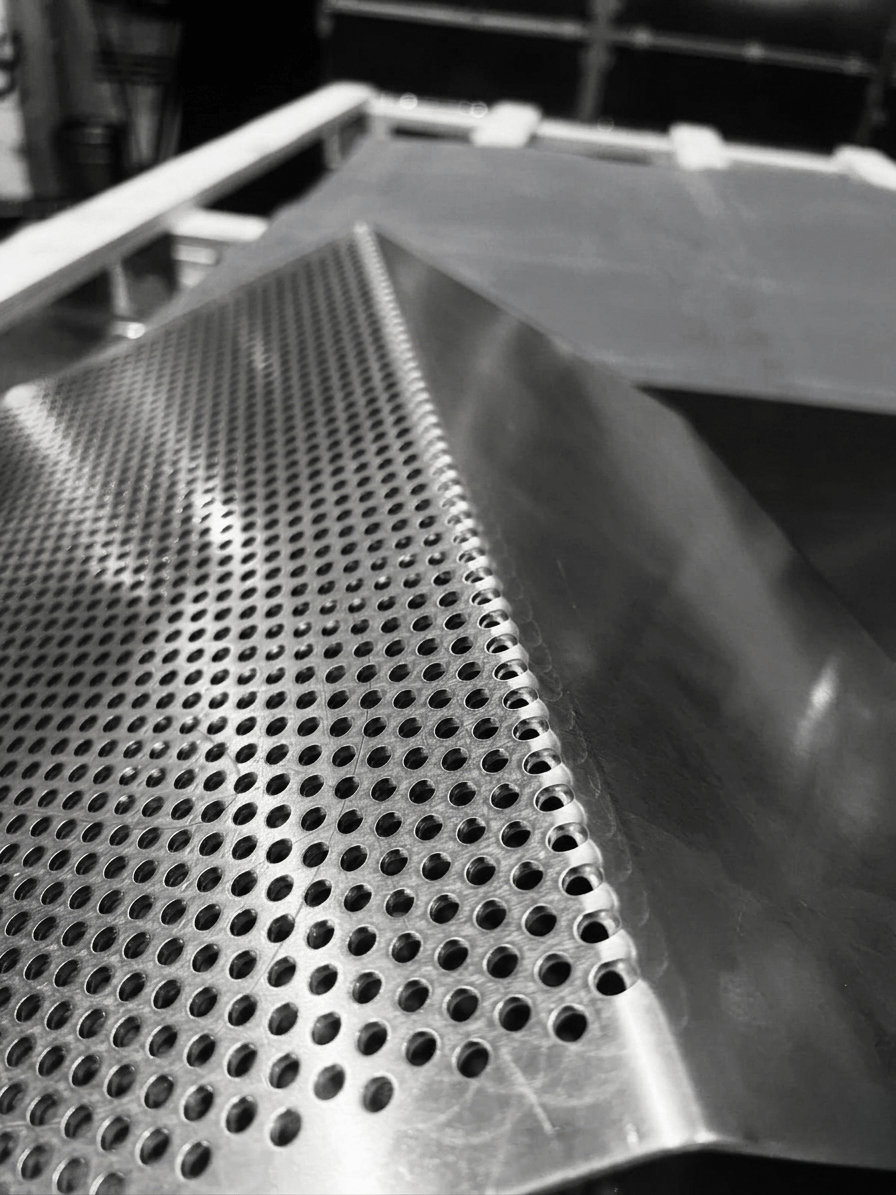
Metal bending and forming
Bending and Forming
Once a sheet has been cut to the correct flat profile, bending transforms it into its three-dimensional final shape. In Singapore, press brake bending is the most commonly used method.
A press brake uses a hardened die to apply controlled force along a line, creating a precise fold at the desired angle. CNC press brakes can produce complex multi-bend profiles to tight angular and dimensional tolerances. The process is essential for producing edge returns on panels, channel sections, box forms, and any component that needs a three-dimensional geometry cut from flat sheet. Key considerations for bending: the minimum bend radius depends on material type and thickness (too tight a radius will crack the material or damage coatings applied before bending); bend allowance must be factored into the flat cutting file to ensure the finished dimension is correct; and some materials — particularly work-hardened stainless steel — require more force and more careful tooling selection than mild steel.
Roll forming curves flat sheet into cylindrical or conical shapes using a series of rollers. This is commonly used for curved cladding panels, column wraps, and any application requiring a consistent curve radius across the full length of a panel, such as corrugated facade panels.
Welding and Joining
Welding joins two or more metal pieces by melting the base material at the joint — with or without filler metal — to form a continuous bond. It is one of the most widely used fabrication processes, and also one of the most variable in quality.
MIG welding (Metal Inert Gas) feeds a continuous wire electrode through a welding gun, shielded by an inert gas. Fast and productive for mild steel and aluminium; widely used in general fabrication and structural work.
TIG welding (Tungsten Inert Gas) uses a non-consumable tungsten electrode and, where needed, a separate filler rod. It produces the cleanest, most precise welds — essential for stainless steel architectural work where weld appearance and hygiene matter, and for thin-gauge materials where burn-through is a risk. Slower and more skill-intensive than MIG, but the quality difference is visible.
Stick welding (arc welding) uses a consumable electrode coated in flux. Versatile and portable — the method of choice for site welding, structural connections, and applications where gas shielding is impractical.
Beyond welding, mechanical joining methods — bolting, riveting, and self-clinching fasteners — are used where joints need to be demountable, where dissimilar metals would cause galvanic issues if welded, or where the heat of welding would distort thin-gauge material.
Finishing and Surface Treatment
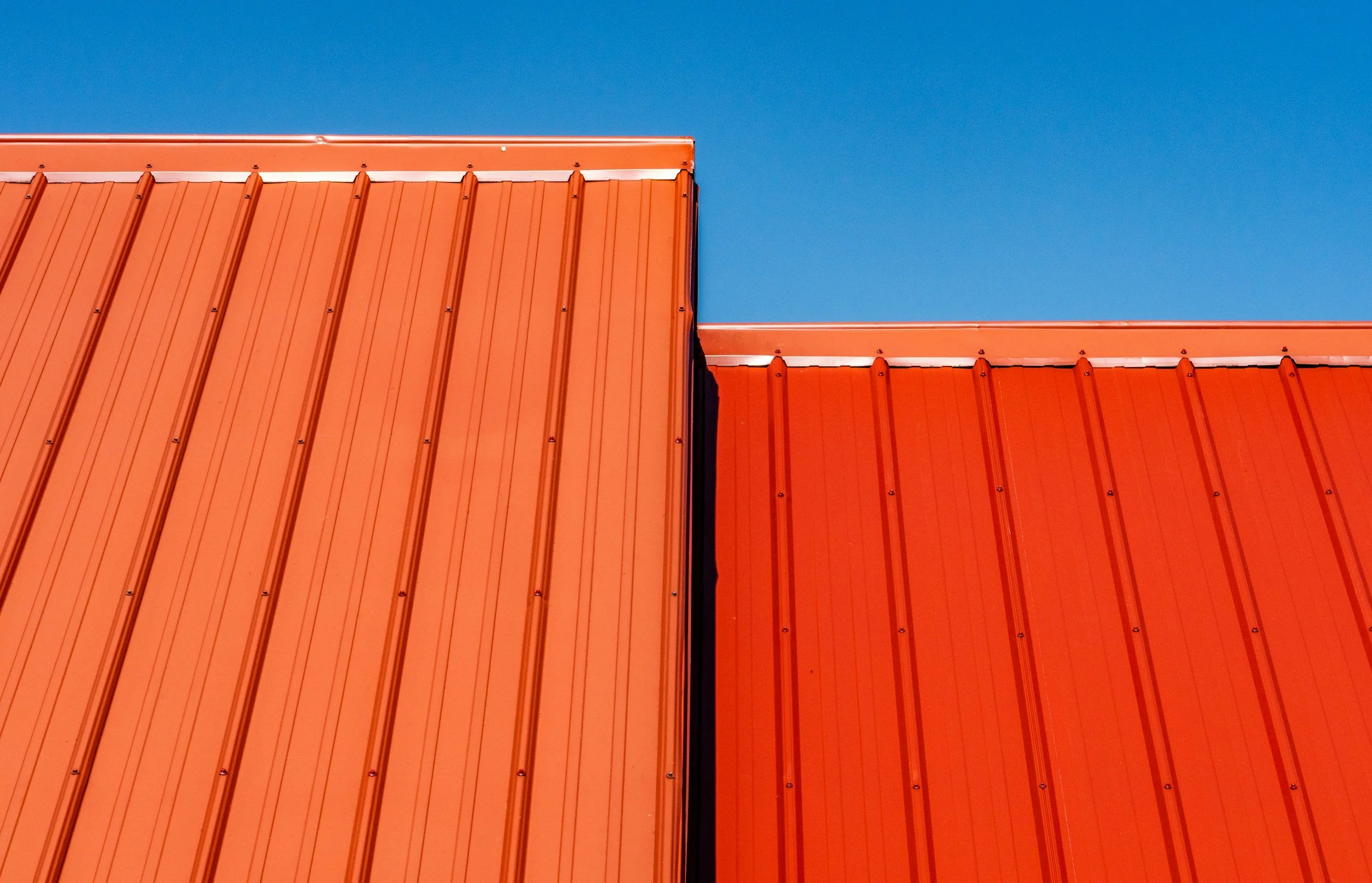
Finishing is not an afterthought — in Singapore's climate and across the range of applications where Supply Bay's products are used, the right surface treatment is what determines whether a fabricated component is able to achieve long-lasting durability.
Powder coating applies a dry electrostatically charged powder to the metal surface, then cures it in an oven to form a hard, durable coating. It is the most common architectural finish for mild steel, aluminium, and galvanised steel in Singapore — providing UV resistance, colour consistency, and a smooth surface that handles cleaning and physical contact well.
PVDF coating is a high-performance fluoropolymer system offering superior fade and chalk resistance compared to standard powder coat. The preferred system for high-rise facade panels and long-maintenance-interval applications, particularly on aluminium.
Hot-dip galvanising immerses fabricated steel in molten zinc, producing a metallurgically bonded zinc coating that resists corrosion from the inside out. The preferred treatment for structural steelwork, civil infrastructure, and any mild steel application in Singapore's outdoor environment where aesthetics are secondary to performance. Used for Supply Bay's expanded mesh in civil applications such as the Bukit Timah Canal widening project.
Brushing and polishing create decorative surface textures on stainless steel — from the linear No. 4 brushed finish commonly seen in commercial interiors to mirror-polished surfaces for high-end architectural applications.
Materials Used in Metal Fabrication
Mild steel
The workhorse of metal fabrication. Mild steel (also called carbon steel or MS) is strong, easy to cut, bend, and weld, and very cost-effective. Its principal limitation for Singapore applications is corrosion resistance — unprotected mild steel will rust quickly in high humidity — so it almost always requires a protective finish (galvanising, powder coating, or both) for any application with moisture exposure.
Mild steel is the go-to material for structural components, industrial fabrication, gate frames, and any application where the finish will provide the corrosion protection and the base material just needs to be strong and economical.
Galvanised steel (GI)
Hot-dip galvanised steel sheet offers the structural properties of mild steel with a pre-applied zinc coating. It is widely used for industrial cladding, plant enclosures, and applications where an economical corrosion-resistant material is needed without the cost of stainless. It can also be laser cut and bent.
Aluminium
Aluminium's combination of light weight, natural corrosion resistance, and good formability makes it the preferred material for facade panels, canopy soffits, ceiling systems, and any application where structural weight is a constraint. It accepts powder coating and PVDF coating well, offering a wide colour palette. The main trade-off versus steel is lower strength-to-weight ratio at equivalent thickness, which needs to be addressed through panel geometry (returns, ribs, corrugations) or by increasing the gauge.
Stainless steel (SS304 and SS316)
Stainless steel's chromium content — a minimum of 10.5% — creates a self-repairing passive oxide layer that gives it inherent corrosion resistance without additional treatment. This makes it the preferred material for architectural metalwork in Singapore, particularly for facades, exterior screens, and any application where maintenance access is limited.
SS304 is the standard architectural grade — suitable for most interior and semi-sheltered exterior applications in Singapore. SS316 adds molybdenum to the alloy, significantly improving resistance to chloride pitting — the relevant specification for coastal Singapore locations, food processing environments, and applications with regular exposure to cleaning chemicals.
Stainless steel is more expensive than mild steel and requires more care during fabrication — TIG welding for quality joints, passivation after any machining or welding, and attention to surface finish consistency — but the long-term performance in Singapore's climate justifies the premium for most architectural applications.
Work with Supply Bay on Your Next Fabrication Project
Supply Bay supplies and fabricates architectural metals for projects across Singapore and the Asia Pacific region — from single-piece prototypes to full project runs, across expanded metal, perforated metal, laser-cut panels, and solid sheet in stainless steel, aluminium, mild steel, and galvanised steel.
Powder coating or PVDF coating: typically adds 3–5 working days.
Bending or folding: quoted individually based on complexity.
Large-volume or complex multi-part jobs: quoted individually based on complexity.