What Do SWM and LWM Mean? How to Read an Expanded Metal Specification
Expanded metal specification sheets use a set of shorthand terms — SWM, LWM, strand width, mesh thickness — that are rarely explained by other suppliers. If you're an architect writing a spec, a contractor checking a delivery, or a QS comparing supplier quotes, understanding what these measurements mean is the difference between ordering the right panel and ordering the wrong one. This guide explains each technical term, how they relate to each other, and what they mean in practice for facade, screen, and structural applications in Singapore.
Key Terms in Expanded Metal Spec Sheet

Short Way of Mesh (SWM)
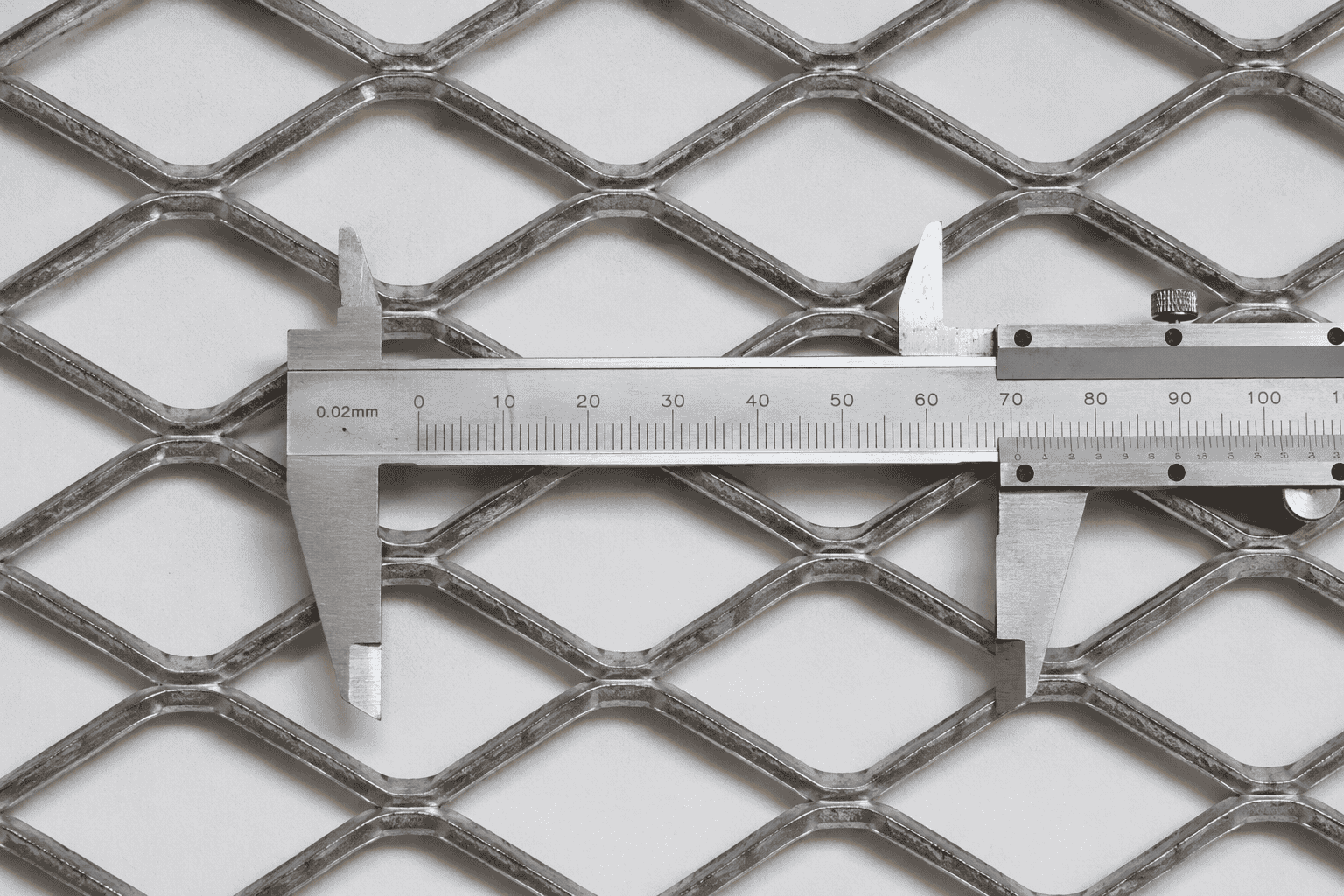
SWM is the width of the diamond aperture measured across the short axis — perpendicular to the direction the sheet was stretched. It is always the smaller of the two aperture dimensions.
SWM controls how dense the mesh looks when viewed straight-on. A low SWM produces a fine, tight mesh with small visible apertures. A high SWM produces an open mesh where the diamond pattern is clearly visible from a distance.
For facade screening applications, SWM is the measurement most relevant to visual privacy — the lower the SWM, the less you can see through the panel at a given viewing distance.
Long Way of Mesh (LWM)
LWM is the length of the diamond aperture along the long axis — parallel to the direction of stretching. LWM is always larger than SWM.
LWM affects the structural behaviour of the panel more than SWM does. A larger LWM means longer, more slender strand segments between nodes — which reduces the panel's resistance to deflection under point load. For walkway and structural applications, a shorter LWM relative to strand width is preferred.
Strand Width (SW)
SW is the width of each individual metal strand that forms the mesh. It is measured across the flat face of the strand.
Strand width is the primary indicator of panel weight and material density. A fine mesh with 1.5mm strands will be significantly lighter than a structural mesh with 5mm strands at the same sheet thickness. For facade panels where self-weight affects the fixing design, SW is the figure your structural engineer will want alongside the sheet thickness.
Sheet Thickness (ST)
Thickness determines the depth of each strand and, together with strand width, controls the panel's load-bearing capacity.
Open Area
Open area is the proportion of the panel's surface area that is void — the apertures rather than the metal. It is expressed as a percentage and calculated from the SWM, LWM, and strand width, and sheet thickness dimensions.
Open area directly affects: solar heat gain through a facade screen, airflow through a ventilated panel, visual transparency at different viewing distances, and acoustic performance when used as a ceiling or screen. For BCA Green Mark projects, open area feeds into ETTV calculations for facade screening elements.
How Open Area Is Calculated
Open area percentage for expanded metal is calculated using the formula:
Open Area (%) = (SWM × LWM) / ((SWM + SW) × (LWM + SW + ST÷2)) × 100
The four-variable formula above matches standard fabrication practice and is consistent with how Supply Bay's product specifications are calculated.
Use the calculator below to check open area for any combination of SWM, LWM, SW, and ST.
Expanded Metal Open Area Calculator
Common Expanded Metal Profiles and Their Typical Specs
| Product | SWM (mm) | LWM (mm) | SW (mm) | ST (mm) | Approx. Open Area | Typical Use |
|---|---|---|---|---|---|---|
| Fine mesh | 4 – 8 | 8 – 16 | 1.0 – 1.5 | 0.8 – 1.2 | 25 – 35% | Interior screens, close-view facade infill, decorative panels |
| Medium mesh | 10 – 20 | 20 – 40 | 2.0 – 3.0 | 1.2 – 2.0 | 35 – 45% | Exterior facade screens, car park cladding, rain screens |
| Louver mesh | 20 – 35 | 40 – 70 | 3.0 – 4.0 | 1.5 – 2.5 | 40 – 52% | Ventilated facades, M&E plant room screens, louvre systems |
| Walkway / heavy mesh | 25 – 50 | 50 – 100 | 4.0 – 8.0 | 3.0 – 6.0 | 45 – 55% | Walkway grating, access platforms, structural facade panels |
| Anti-climb mesh | 6 – 12 | 12 – 20 | 3.0 – 5.0 | 2.0 – 3.0 | 20 – 30% | Security fencing, perimeter screens, anti-climb barriers |
What to Check When Comparing Quotes from Different Suppliers
Suppliers don't always use identical product codes. Two panels described as "medium expanded metal mesh" can have different specs. When comparing quotes, verify:
SWM and LWM — these define the aperture and open area, not just the product name.
Strand width — a lower SW at the same mesh size means lower weight and reduced structural performance.
Sheet thickness.
Alloy grade — 1100 and 5052 are both aluminium but have different corrosion resistance; SS304 and SS316 are both stainless steel but perform differently in coastal conditions.
Frequently Asked Questions
-
SWM (short way of mesh) is the width of the diamond aperture across the narrow axis. LWM (long way of mesh) is the length along the long axis, in the direction the sheet was stretched. LWM is always larger than SWM. Together they define the aperture size and shape, and determine the open area of the panel.
-
Expanded metal panels have a directional orientation — the long way of mesh runs in one direction. If panels are installed rotated 90° from the intended orientation, the visual pattern will look different even though the material is identical. On facade applications where visual alignment matters, confirm the panel orientation with the supplier before fabrication and mark the installation direction on delivery.
-
Item Supply Bay provides full technical data sheets for all expanded metal profiles, including SWM, LWM, SW, ST, weight per m², and open area percentage. Contact us at info@supplybaystore.com.
Supply Bay Pte Ltd supplies expanded metal mesh for facade, cladding, and structural applications across Singapore. Contact us at info@supplybaystore.com or +65 6524 3913.
Supply Bay is Singapore's leading supplier of architectural sheet metal — expanded mesh, perforated panels, laser-cut screens, and solid sheets in aluminum, stainless steel (SS304, SS316), mild steel, and galvanized steel.