
Perforated Metal Facades Singapore: Specification Guide for Architects and Designers
Perforated metal facades are used across Singapore's commercial, residential, and institutional buildings for solar screening, natural ventilation, privacy control, and decorative cladding. This guide addresses the specification questions architects and interior designers ask most often — covering perforation options, panel sizing, material grades, finishes, ETTV performance, and retrofit applications.
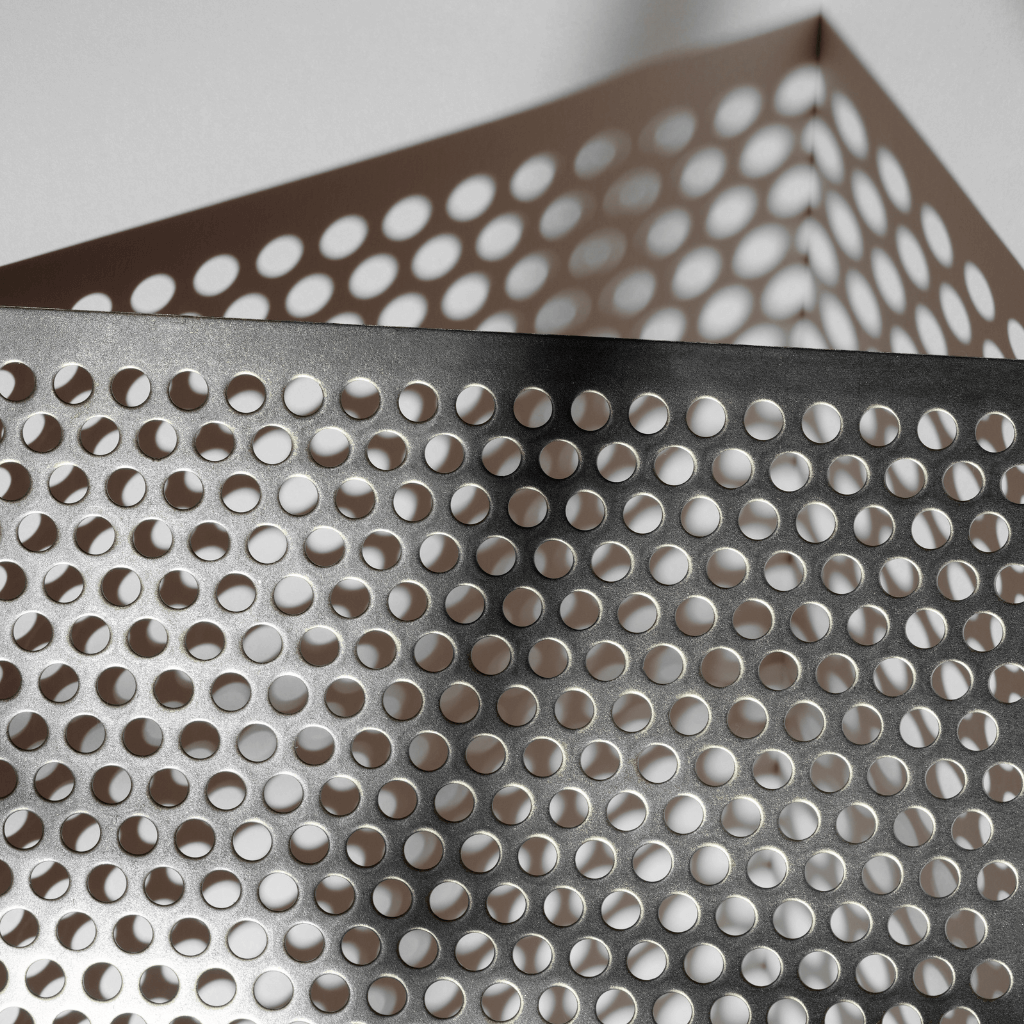
What Are the Practical Advantages of Perforated Metal Cladding?
Perforated metal gives architects direct control over three envelope performance variables simultaneously: natural light transmission, airflow, and solar heat gain — all determined by the open area percentage of the panel.
Large perforations (high open area) maximise natural light and cross-ventilation, reducing dependence on artificial lighting and mechanical cooling. This is directly relevant to Singapore's BCA Code for Environmental Sustainability, which requires non-residential buildings to meet ETTV limits. A perforated metal screen installed as a secondary facade layer intercepts solar radiation before it reaches the primary wall or glazing surface, reducing the solar heat gain component of the ETTV calculation.
Lower open area percentages (under 40%) provide privacy screening while still allowing partial light and air transmission. This makes perforated metal applicable across a wide range of facade types — from fully open screens on carpark and industrial facades to close-pitched panels on residential and commercial frontages.
The open-area geometry also prevents water pooling on the panel surface, reducing biological fouling and corrosion risk compared to solid cladding in Singapore's high-humidity, high-rainfall conditions.
What Perforation Options Are Available?
There are no practical restrictions on hole size or density, provided panels are designed to maintain structural integrity and resist warping under the specified span and wind load.
Hole Shapes
Standard punch-die patterns include round, square, slotted, hexagonal, and elongated holes.
Custom geometries — including brand-specific or architect-designed patterns — can be produced by laser cutting to ±0.1 mm tolerance.
Open Area Percentage
Open area is determined by hole diameter and pitch (centre-to-centre spacing). The table below shows typical open area ranges for common hole patterns:
| Hole Pattern | Open Area Range | Typical Application |
|---|---|---|
| Round, staggered pitch | 1–61% | Facade screens, linkway panels, carpark cladding |
| Round, straight pitch | 1–50% | Privacy screens, bin centres, semi-opaque cladding |
| Square hole, straight pitch | 15–33% | Decorative panels, feature walls, lobby screens |
| Slotted / elongated hole | 12–60% | Balustrade infill, low-level screens, acoustic panels |
| Custom laser-cut geometry | Variable by design | Design-led facade features, branded panels |
Tip
For privacy-sensitive applications such as residential frontages, gate panels, screen walls, open area below 30% is the standard starting point. For carpark facades, industrial screening, and ventilation-critical applications, open area above 35% is typical.
Can Perforated Cladding Panels Be Customised?
Panel dimensions, perforation pattern, material grade, and surface finish are all specifiable to project requirements. Standard sheet size is 1220 mm × 2440 mm, but panels can be supplied cut to any dimension required by the facade grid. Maximum panel size depends on material, thickness, and the specified perforation pattern — Supply Bay can advise on the maximum practical size for a given specification to ensure panels resist warping under Singapore's wind and thermal cycling conditions.
The table below summarises the main customisation parameters:
| Parameter | Options | Notes |
|---|---|---|
| Panel dimensions | Standard 1220 × 2440 mm; custom cut to any size | Max size depends on material and perforation — confirm with Supply Bay |
| Hole shape | Round, square, slot, hexagonal, custom laser-cut | Custom geometries via laser cutting to ±0.1 mm tolerance |
| Hole diameter | 1.5 mm – 25 mm (standard punch die range) | Larger openings available by laser cutting |
| Open area | 20–65% (standard); variable by custom design | Higher open area reduces structural rigidity |
| Material | Aluminium, mild steel, GI, SS304, SS316 | Grade selected by exposure condition and finish requirement |
| Thickness | 0.8–4.0 mm depending on material | Thicker panels for structural or wind-load applications |
| Surface finish | Powder coat, PVDF, mill finish, anodised, HDG | PVDF for high-UV or semi-external facades; powder coat for standard internal/external |
| Fabrication | Flat sheet; bending; folded edge returns | Folded returns for panel framing and edge finishing |
For a full overview of finish options, refer to the Metal Finishes Explained guide.
Material Grade Selection for Singapore Facades
Material grade determines long-term corrosion performance and maintenance requirements. The table below covers the main options for facade applications in Singapore's climate.
| Material | Corrosion Resistance | Weight | Typical Use |
|---|---|---|---|
| Aluminium | High (natural oxide layer) | Low | Facade cladding, decorative panels, semi-external screens |
| Mild steel, powder coat | Medium (coating-dependent) | Medium | Internal screens, sheltered external panels |
| Galvanised mild steel (GI) | High (zinc layer) | Medium | Outdoor enclosures, NRP/ROH screens, bin centres |
| SS304 stainless steel | High | Medium–high | Architectural facades, semi-coastal applications |
| SS316 stainless steel | Very high | Medium–high | Coastal, waterfront, and marine-adjacent facades |
For detailed grade selection guidance, refer to the Stainless Steel vs Galvanised Steel guide.
Can Perforated Cladding Be Retrofitted to an Existing Building?
Perforated metal cladding can be fixed to existing building facades as a secondary screen layer without requiring structural alterations to the primary envelope. The panels are mounted on a standoff subframe — typically aluminium or galvanised steel — anchored to the existing wall or structural frame. This approach is used across Singapore for both functional and design purposes.
Common retrofit applications include:
Older commercial and industrial buildings where the existing facade does not meet current ETTV requirements — a perforated screen layer reduces solar heat gain without replacing the primary cladding.
Heritage shophouses in Katong, Joo Chiat, and Chinatown where perforated panels are used as internal screens, room dividers, and decorative wall features without affecting the conserved external envelope.
Residential developments where perforated screens are added to balconies, service yards, and entrance areas to provide privacy or solar shading.
HDB and public housing upgrading projects under the NRP and ROH programmes, where perforated panels replace ageing grille or solid infill in existing structures.
Note: For retrofits on conserved buildings, confirm panel fixing methodology and any visual impact with the relevant conservation authority (URA or NHB) before finalising the specification. Fixings to conserved facades require approved methods that do not permanently damage the original fabric.
Applications in Singapore Green Building Projects
How Does Perforated Metal Cladding Affect Energy Efficiency?
Perforated metal contributes to building energy performance through two mechanisms: solar shading and natural ventilation.
As a secondary facade screen, perforated metal intercepts direct solar radiation before it reaches the primary wall or glazing surface. The shaded cavity between screen and wall runs at significantly lower surface temperatures than an exposed facade, reducing the solar heat gain component of the ETTV calculation that non-residential buildings must satisfy under BCA's Code for Environmental Sustainability. Open area and screen setout distance both affect the degree of solar interception — a closer setout with lower open area provides more aggressive shading; a wider setout with higher open area allows more diffuse light while still providing partial shading.
For buildings targeting BCA Green Mark certification, a perforated facade screen contributes to the Energy Efficiency section through ETTV reduction and, where the open area allows passive airflow, to natural ventilation credits in transitional or semi-open spaces.
For a full breakdown of how perforated and expanded metal mesh contribute to Green Mark criteria, refer to the Expanded Metal Mesh Sustainability and Green Mark guide.
-
Standard sheet size is 1220 mm × 2440 mm.
Custom sizes are available up to 1500mm x 3000mm — maximum practical dimensions depend on material, thickness, and perforation pattern.
-
For facades with full outdoor exposure in Singapore, PVDF (Fluorocarbon) coating on aluminium is the highest-durability finish — providing long-term UV resistance and colour stability in tropical conditions.
Polyester powder coat on aluminium or mild steel is appropriate for sheltered external and internal applications.
-
Yes. Panels can be powder coated to any RAL or custom colour specification. PVDF coating is available for aluminium panels requiring higher UV and colour retention performance. Allow additional lead time for custom colour finishes — typically 1–2 weeks from order confirmation.
-
Standard perforated metal sheets in stock specifications are available within 1–2 working days. Custom cut-to-size panels, non-standard perforation patterns, and powder-coated or PVDF-finished panels are typically ready within 1–2 weeks. Contact Supply Bay early in the procurement process for programme-critical orders.
-
Yes. Product data sheets, material certificates, coating test reports, and open area data are available to support architect submittals, and contractor material approval packages.
Supply Bay Pte Ltd supplies perforated metal sheet and laser-cut panels for facade, screening, and cladding applications across Singapore construction and architectural projects. Contact us at info@supplybaystore.com or +65 6524 3913.
Supply Bay is Singapore's leading supplier of architectural sheet metal — expanded mesh, perforated panels, laser-cut screens, and solid sheets in aluminum, stainless steel (SS304, SS316), mild steel, and galvanized steel.


[Updated 2026] How expanded metal and perforated metal contribute to BCA Green Mark certification in Singapore — covering ETTV, passive ventilation, Whole Life Carbon, and the 80-80-80 Green Building Masterplan targets.