
Stainless Steel vs Galvanised Steel: Which Should You Specify for Singapore Projects?
Stainless steel and galvanised steel look similar off the shelf. Both are corrosion-resistant, both are widely available in Singapore, and both show up in architectural, construction, and industrial specifications. The differences between them only become obvious after installation.
This guide covers how each material performs in Singapore's climate, what the fabrication differences mean for your project, and a clear breakdown of which applications suit each grade.
This guide breaks down the key differences, explains how each material behaves in Singapore's specific climate conditions, and provides clear guidance on when to specify each.
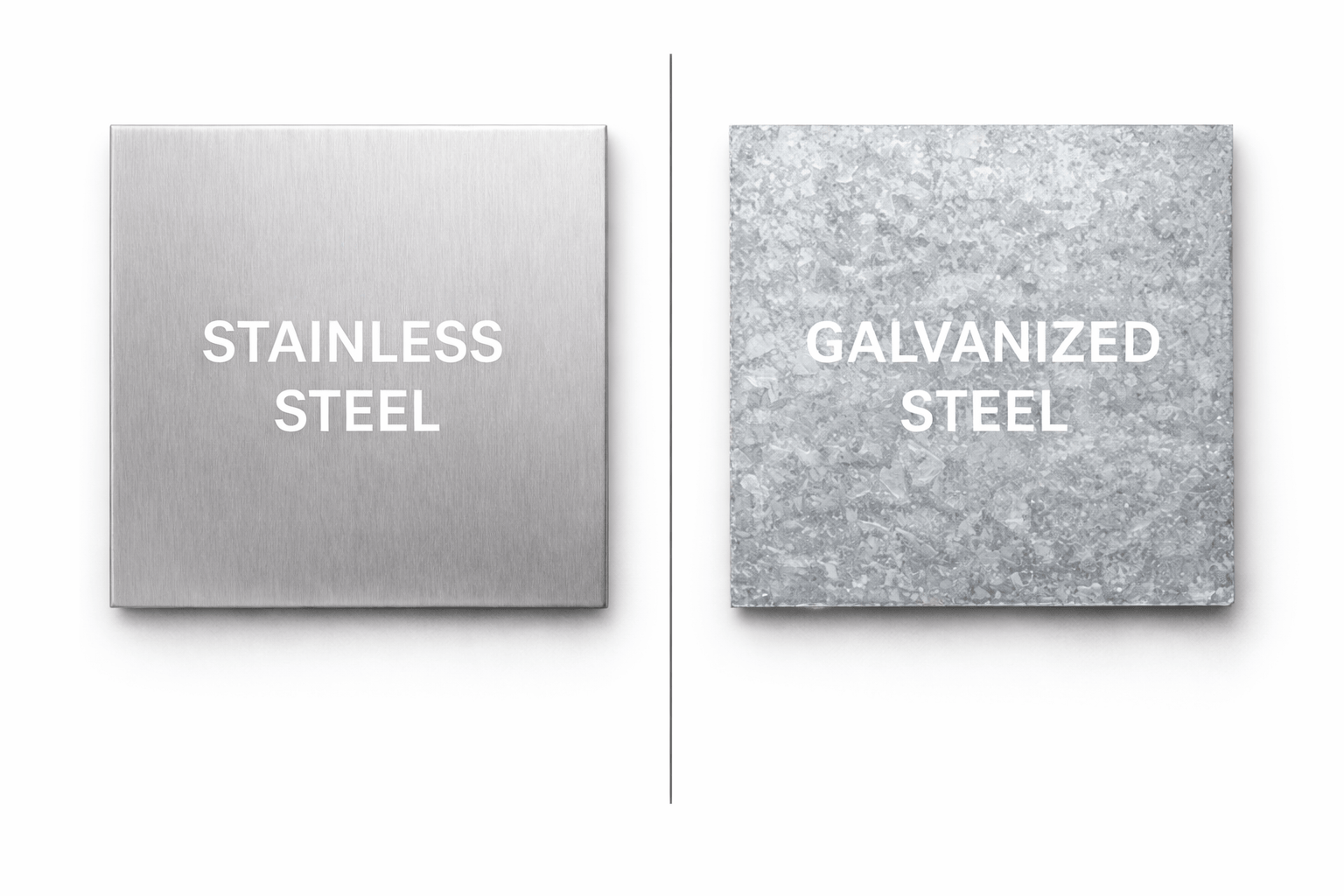
Finishing comparison: Stainless steel vs Galvanised Steel
Differences between Stainless Steel and Galvanised Steel
Stainless steel
Stainless steel gets its corrosion resistance from chromium — a minimum of 10.5% by composition. Chromium reacts with oxygen to form a stable oxide layer on the surface that is self-repairing: scratch it, cut it, or drill through it, and the layer reforms on its own when exposed to air. The corrosion resistance is built into the metal, not applied to it.
The two grades most commonly specified in Singapore are:
SS304: General architectural and construction use; appropriate for most interior and semi-sheltered exterior applications inland.
SS316: Contains added molybdenum for significantly stronger chloride resistance. The correct specification for coastal locations, waterfront developments, and environments with salt air or chemical exposure.
Galvanised steel
Galvanised steel is mild steel coated with a layer of zinc, applied either by hot-dip galvanising (immersion in molten zinc at approximately 450°C) or electrogalvanising (electrochemical deposition of a thinner zinc layer).
Zinc protects the underlying steel through sacrificial corrosion — it corrodes preferentially, delaying rust formation in the base steel. Once the zinc layer is consumed or mechanically damaged, the base steel is exposed and rusts rapidly. There is no self-healing mechanism. Cut edges, drilled holes, and weld zones where the zinc has burned off are all vulnerable points.
| Property | Stainless Steel (SS304/SS316) | Galvanised Steel |
|---|---|---|
| Corrosion protection | Inherent (chromium oxide layer) | Surface coating (zinc) |
| Self-healing at cut edges | Yes | No |
| High humidity performance | Excellent | Moderate |
| Coastal / salt air suitability | SS316: Excellent; SS304: Good | Moderate without maintenance |
| Welding behaviour | TIG weld + passivation maintains resistance | Zinc burns off; weld zone needs touch-up |
| Outdoor service life in Singapore | 20–30+ years | Variable; accelerated depletion in humidity |
| Upfront cost | Higher | Lower |
Corrosion Performance in Singapore's Climate
Standard temperate-climate specifications do not translate directly to Singapore conditions:
Relative humidity consistently above 80%
Year-round temperatures of 25–33°C — no seasonal drying cycles
High UV exposure
Salt-laden coastal air across a significant portion of the island
Acid rain in urban and industrial zones
These conditions accelerate corrosion in ways that temperate climate specifications do not anticipate. A galvanised steel specification that would last 25 years in a dry European environment may fail significantly faster in Singapore.
Tip
The 5km Rule - specify SS316 for any project within approximately 5km of the coast, and for all waterfront developments. SS304 is generally sufficient for inland exterior applications without chemical or salt air exposure.
Galvanised steel in Singapore
In Singapore's permanently humid, high-UV environment, galvanised steel's zinc layer is consumed faster than in temperate climates. The absence of seasonal drying cycles means the steel surface is exposed to moisture continuously rather than intermittently. In coastal locations, chloride ion concentration in the air dramatically accelerates zinc depletion.
Hot-dip galvanised mild steel is less ideally specified for coastal zones or applications with regular moisture contact.
Fabrication, Welding, and Site Handling
Stainless steel
Stainless steel (SS304 and SS316) welds cleanly without significant fume hazard beyond standard ventilation requirements. Weld zones maintain their corrosion resistance when correctly TIG welded, and post-weld passivation restores the passive oxide layer at the weld zone and heat-affected area. Cut edges on stainless steel panels do not require treatment for most architectural applications — the material's inherent corrosion resistance extends to cut surfaces.
Galvanised steel
Welding galvanised steel burns off the zinc coating in and around the weld zone, generating zinc oxide fumes that are a health hazard requiring controlled ventilation. Weld zones and the surrounding heat-affected area are left with bare steel that has no corrosion protection — they must be treated with a cold galvanising compound or zinc-rich primer before the installation is considered weatherproof.
Cut edges on galvanised steel similarly expose bare mild steel. On site in Singapore's humidity, untreated cut edges will begin to rust within days. This is a practical maintenance issue for any galvanised steel installation that involves significant cutting and drilling on site — which covers most projects.
Applications: When to Specify Each in Singapore
Specify stainless steel when:
The installation is permanently outdoor and exposed to Singapore's weather
The project is within coastal salt air range or directly at a waterfront location
The application involves regular water contact, cleaning chemicals, or food-adjacent conditions
The metal surface is visible at close range and surface appearance over time matters
Long maintenance intervals or limited maintenance access are expected
Common Singapore applications: architectural facade panels, balustrades and railings, staircase infill panels, lift lobby wall cladding, external signage elements, perforated facade screens, expanded mesh in occupied buildings, public infrastructure hardware.
Specify galvanised steel when:
The application is sheltered or in a controlled indoor environment
Budget is the primary driver and the environment is mild or non-coastal
The application is industrial or functional
Common Singapore applications: structural support framing in sheltered locations, cable tray and M&E support systems, industrial walkway grating and platforms, construction-phase temporary works, site hoarding.
Supply Bay's Stainless Steel and Galvanised Products
Supply Bay supplies both stainless steel and galvanised steel across our full product range:
Stainless steel (SS304 / SS316):
Expanded metal mesh — architectural screens, facades, railings, ceiling panels
Perforated metal sheet — facade cladding, acoustic panels, decorative screens
Laser-cut panels — custom decorative and architectural elements
Solid stainless steel sheet — cladding, feature surfaces, fabrication
Galvanised steel:
Expanded metal mesh (galvanised) — industrial walkways, civil infrastructure, platform grating
Perforated metal sheet (galvanised) — bin centre enclosures, ventilation panels, HDB upgrading works
Corrugated sheets (galvanised) — roofing, cladding, site hoardings
For project-specific grade recommendations, our team can advise based on your application environment, span requirements, and specification constraints.
-
For corrosion resistance and long-term performance in Singapore's outdoor environment, stainless steel outperforms galvanised steel in most applications. However, galvanised steel remains appropriate for sheltered, short-term, or budget-constrained applications where the environment is mild and maintenance is manageable.
-
Yes. SS304 and SS316 can be powder coated in any RAL or custom colour. Surface preparation is more demanding than for mild steel as the passive oxide layer requires treatment before the coating will adhere correctly. Powder-coated stainless steel is commonly used in Singapore for applications where both corrosion resistance and specific colour are required.
-
For sheltered void deck and internal common area applications, SS304 is generally appropriate. For exposed external railings, facade panels, or applications near to the coast, SS316 is the more robust specification. Contact Supply Bay with your project location and application for a specific grade recommendation.
-
Yes. Most Supply Bay products — expanded metal mesh, perforated metal sheet, laser-cut panels, and solid sheet — are available in both stainless steel (SS304 / SS316) and galvanised mild steel. Contact us with your specification requirements for a quotation.
Not Sure Which to Specify?
Our team can advise on material grade selection based on your project's location, application, and performance requirements. We supply stainless steel and galvanised steel products for architectural, commercial, industrial, and public infrastructure projects across Singapore and the Asia Pacific region.
Supply Bay is Singapore's leading supplier of architectural sheet metal — expanded mesh, perforated panels, laser-cut screens, and solid sheets in aluminum, stainless steel (SS304, SS316), mild steel, and galvanized steel.

![Perforated Metal vs Expanded Metal: Which to Specify? [Singapore Guide]](https://images.squarespace-cdn.com/content/v1/5ffda43ce68b407462b48370/1724812968348-RHOHVT1NCQFOIJH0ABWN/shutterstock_2474433195.jpg)