
Metal Fabrication Singapore: Processes, Materials, and Specification Guide for Architects and Contractors
Metal fabrication covers a wider range of processes than cutting and welding. Choosing the right combination — for a given material, application, and project programme — affects cost, lead time, finish quality, and long-term performance. This guide covers the key fabrication processes used in Singapore's construction and architectural sectors, the materials most commonly specified, and how to match process to application at the design and procurement stage.
What is Metal Fabrication?
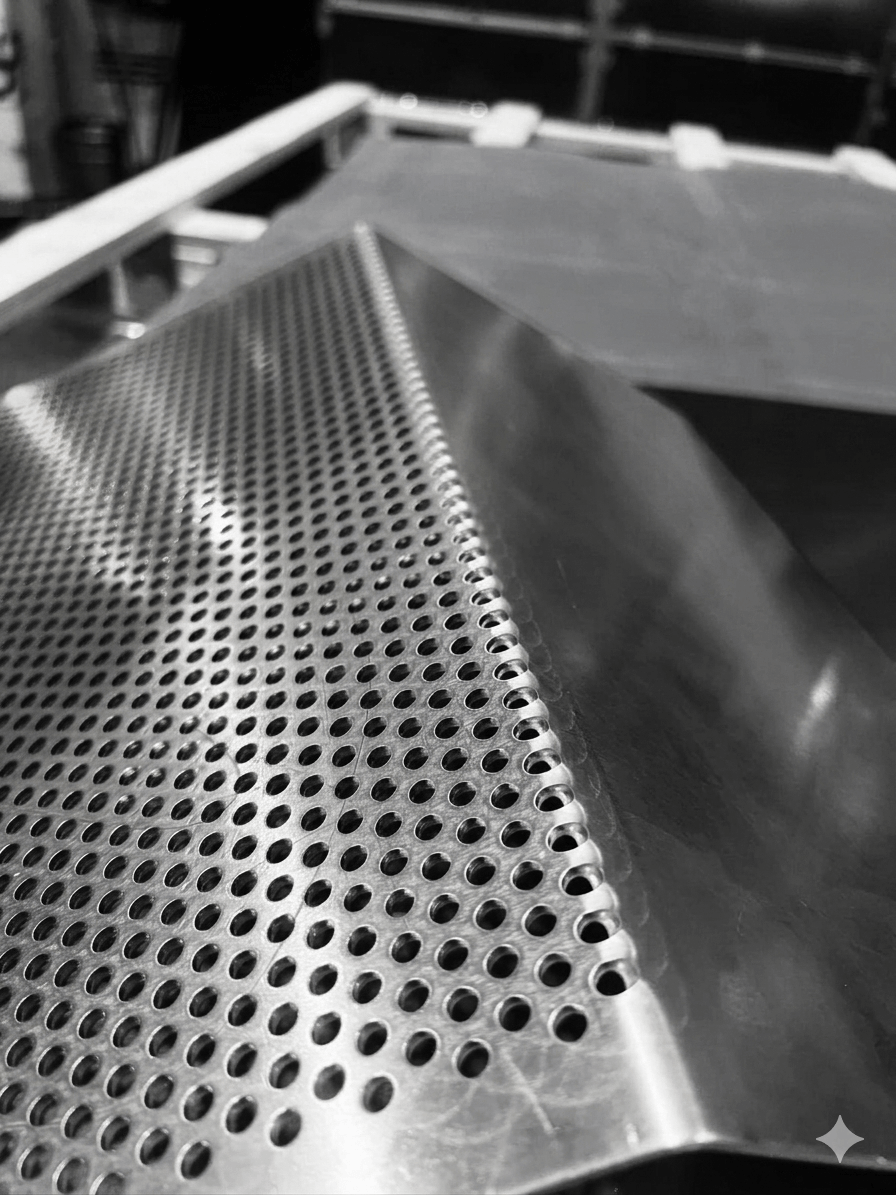
Metal fabrication transforms raw or semi-finished metal material — flat sheet, plate, bar, or structural section — into a finished product or component through a sequence of forming, cutting, joining, and finishing operations. Most fabricated products go through more than one process: a laser-cut facade panel is typically cut, then bent, then powder coated. A perforated metal panel may be folded at the edges and brushed to finish.
Understanding the sequence, and how each stage affects the material, is what separates a well-specified job from an expensive one.
Key Metal Fabrication Processes
Cutting
Cutting is where almost every fabrication job begins. The method chosen affects edge quality, dimensional tolerance, geometry complexity, and the range of materials that can be processed.
| Cutting Method | Process | Edge Quality | Geometry | Typical Use |
|---|---|---|---|---|
| Laser cutting | CNC laser beam vaporises material along programmed path | Clean, burr-free; ±0.1 mm tolerance | Any — unlimited vector geometry | Custom panels, architectural metalwork, cut-to-size sheet |
| Waterjet cutting | High-pressure water + abrasive; cold process, no heat-affected zone | Clean; no thermal distortion | Complex profiles | Heat-sensitive materials; thick plate |
| Shearing | Straight blade makes linear cuts across sheet | Good for straight edges | Straight lines only | Blank cutting; simple rectangular sheet sizes |
| Punching / perforating | Punch die forces through sheet under press | Clean hole; slight burr on exit face | Standard die shapes: round, square, slot, hex | Perforated metal sheet production |
Supply Bay's laser cutting service handles mild steel up to 25 mm, stainless steel up to 20 mm, aluminium up to 12 mm, and galvanised steel up to 25 mm, with a maximum sheet size of 3,015 mm × 1,524 mm and a cutting tolerance of ±0.1 mm. For custom laser-cut panels — facade features, screen panels, decorative elements — laser cutting is the appropriate process in every case where the geometry cannot be produced by a standard punch die.
Bending and Forming
Once a sheet is cut to the correct flat profile, bending transforms it into its three-dimensional final geometry. In Singapore, press brake bending is the most common method for architectural metalwork. A press brake uses a hardened die to apply controlled force along a line, producing a precise fold at the specified angle. CNC press brakes produce complex multi-bend profiles to tight angular and dimensional tolerances. This process is essential for edge returns on panels, channel sections, box forms, and any component that requires a three-dimensional shape cut from flat sheet.
Three considerations matter most at the specification stage:
Minimum bend radius: The minimum radius before a material cracks or a pre-applied coating is damaged depends on material grade and thickness. This must be confirmed before applying coatings — some finishes must go on after bending, not before.
Bend allowance: The flat cutting file must account for material consumed in the bend. A finished dimension specified without bend allowance will produce an undersized component.
Material behaviour: Work-hardened stainless steel requires more force and more careful tooling selection than mild steel. Aluminium bends cleanly but springback must be compensated in the die angle.
Roll forming — which curves flat sheet into cylindrical or conical shapes using a series of rollers — is used for curved cladding panels, column wraps, and corrugated sheets where a consistent curve radius is required across the full panel length.
Welding and Joining
Welding joins metal pieces by melting the base material at the joint, with or without filler metal, to form a continuous bond. Process selection determines weld quality, visual appearance, and suitability for the material being joined.
| Process | Method | Weld Quality | Typical Use in Singapore |
|---|---|---|---|
| MIG welding | Continuous wire electrode; inert gas shield | Good; fast and productive | Mild steel and aluminium; general fabrication and structural work |
| TIG welding | Non-consumable tungsten electrode; separate filler rod | Highest quality; clean, precise weld bead | Stainless steel architectural work; thin-gauge materials; visible joints |
| Stick welding (arc) | Consumable flux-coated electrode | Moderate; versatile | Site welding; structural connections; where gas shielding is impractical |
Where welds will be visible — stainless steel balustrades, feature panels, lobby screens — TIG welding is the correct specification. MIG is appropriate for structural and non-visible joints where production speed is the priority. For joints that need to be demountable, or where dissimilar metals would cause galvanic corrosion if welded, mechanical joining — bolting, riveting, or self-clinching fasteners — is the appropriate method.
Finishing and Surface Treatment
In Singapore's tropical climate, surface treatment determines whether a fabricated component achieves its specified service life. It is not a secondary decision — it is as important as material grade selection.
| Finish | Process | Performance | Typical Application |
|---|---|---|---|
| Powder coat | Electrostatic powder applied and oven-cured | Good UV resistance; full RAL colour range; hard surface | Mild steel, aluminium, GI — internal and external sheltered applications |
| PVDF coating | Fluoropolymer system applied to aluminium | Superior fade and chalk resistance; 20+ year colour retention | High-rise facade panels; semi-external aluminium; long maintenance interval applications |
| Hot-dip galvanising (HDG) | Fabricated steel immersed in molten zinc | Metallurgically bonded zinc; sacrificial corrosion protection | Structural steelwork; civil infrastructure; outdoor mild steel with no aesthetic requirement |
| No. 4 brushed finish | Mechanical abrasion producing linear grain | Durable decorative finish; hides minor scratches | Stainless steel architectural panels, balustrades, lift interiors |
| Mirror polish | Progressive polishing to reflective surface | High-end decorative; shows surface contact | Feature panels, lobby elements, premium retail |
For a full guide to surface finish options, refer to the Metal Finishes Explained guide.
Material Grades Used in Metal Fabrication Singapore
Material selection determines structural performance, corrosion resistance, fabrication behaviour, and whole-life cost. The table below covers the grades most commonly specified in Singapore's construction and architectural sectors.
| Material | Corrosion Resistance | Fabricability | Relative Cost | Typical Singapore Application |
|---|---|---|---|---|
| Mild steel (MS) | Low — requires protective finish | Excellent — cuts, bends, welds easily | Lowest | Structural components, gate frames, industrial fabrication |
| Galvanised steel (GI / HDG) | High (zinc layer) | Good — laser cuttable and bendable | Low–medium | Industrial cladding, plant enclosures, NRP/ROH screens |
| Aluminium | High (natural oxide layer) | Good — lightweight; springback requires compensation in bending | Medium | Facade panels, ceiling systems, canopy soffits, semi-external screens |
| SS304 stainless steel | High | Good — TIG welding required for architectural joints | High | Architectural facades, balustrades, interior features, semi-coastal applications |
| SS316 stainless steel | Very high (molybdenum addition resists chloride pitting) | Good — more force required than SS304 | Higher | Coastal facades, waterfront applications, food processing, high-humidity environments |
Tip:
Unprotected mild steel will corrode rapidly in Singapore's high-humidity conditions. Any mild steel specification for outdoor or semi-exposed applications must include a protective finish — hot-dip galvanising for structural or civil applications, powder coat or PVDF for architectural panels. Stainless steel eliminates the coating dependency but at a higher material cost.
For detailed guidance on choosing between SS304, SS316, and galvanised steel for Singapore projects, refer to the Stainless Steel vs Galvanised Steel guide.
Matching Process to Application: Singapore Reference Guide
| Application | Recommended Process | Material | Key Consideration |
|---|---|---|---|
| Custom facade panel (custom pattern) | Laser cutting + bending + powder coat or PVDF | Aluminium or mild steel | Sequence: cut → bend → coat |
| Perforated screen panel (standard hole pattern) | Punch perforation + shearing to size + powder coat | Aluminium, GI, or mild steel | Open area and hole size govern structural rigidity |
| Stainless steel balustrade | Laser cutting + TIG welding + brushed finish | SS304 (interior); SS316 (coastal or outdoor) | Passivation after welding; consistent grain direction on brushed finish |
| Structural outdoor enclosure | Shearing + MIG welding + hot-dip galvanising | Mild steel (HDG) | HDG applied after all fabrication is complete |
| Ceiling panel (acoustic) | Punch perforation + powder coat | Aluminium | 20–35% open area for acoustic absorption with mineral wool backing |
| Walkway grating | Expanded metal (slit and stretch) + HDG | Mild steel (HDG) | Check SWM for WSH Act slip resistance compliance |
| Curved cladding panel | Shearing + roll forming + powder coat or PVDF | Aluminium or mild steel | Minimum bend radius; consistent curve radius across panel length |
| Feature wall | Laser cutting + brushed or mirror finish | SS304 or aluminium | ±0.1 mm tolerance; confirm minimum web widths for pattern density |
Fabrication Lead Times
Lead time depends on the complexity of the fabrication sequence, material availability, and finish requirements. The table below gives indicative lead times for the most common supply configurations.
| Supply Configuration | Indicative Lead Time |
|---|---|
| Standard stock sheet (no fabrication) | 1–2 working days |
| Cut-to-size (laser or shear) | 2–5 working days |
| Cut-to-size + bending | 5 working days |
| Cut-to-size + powder coat (standard colour) | 5–10 working days |
| Cut-to-size + custom powder coat colour | 5–10 working days |
| Complex multi-operation jobs | Quoted individually |
Important: For programme-critical orders on NRP, ROH, JTC, or HDB projects, confirm material specifications and place orders as early as possible. Custom finishes and non-standard specifications have the least schedule flexibility. Supply Bay recommends engaging at the specification stage rather than at the point of tender award.
-
Laser cutting is the most cost-effective process for custom panel geometries in Singapore. It produces clean, burr-free edges to ±0.1 mm tolerance without tooling costs, making it economical for both prototype quantities and full project runs. Waterjet is more expensive and slower for most architectural applications; shearing is limited to straight cuts only.
-
After. All cutting, bending, and welding must be completed before powder coating is applied. Fabricating through a pre-coated surface damages the coating at cut edges and weld zones, requiring strip-back and recoat. The correct sequence is: cut → form → weld → clean → coat.
-
Hot-dip galvanising provides a metallurgically bonded zinc layer that protects steel sacrificially — even if the coating is scratched, the zinc corrodes preferentially to protect the underlying steel. Powder coat provides a barrier coating that protects only while it remains intact. For structural steelwork and civil infrastructure in Singapore, HDG is the more durable choice. For architectural panels where colour and surface finish matter, powder coat (or HDG followed by powder coat) is the standard specification.
-
Yes. Supply Bay provides product data sheets, material certificates, coating test reports, and dimensional data for all supplied products. Documentation is available to support contractor submittals, BCA Green Mark packages, and project quality plans.
Supply Bay Pte Ltd supplies expanded metal mesh, perforated metal sheet, laser-cut panels, and solid stainless steel sheet for Singapore construction and architectural projects. Contact us at info@supplybaystore.com or +65 6524 3913.
Supply Bay is Singapore's leading supplier of architectural sheet metal — expanded mesh, perforated panels, laser-cut screens, and solid sheets in aluminum, stainless steel (SS304, SS316), mild steel, and galvanized steel.